


For two decades, SEO has been anchored in a predictable formula:
run an audit → fix everything → create content → hope for growth.
This made sense when search behaviour was slower, websites were smaller, and Google updates were infrequent. But in today’s AI-accelerated search landscape, where competitors shift fast, attention is fragmented, and search intent evolves in real time, the traditional approach simply moves too slowly to create competitive advantage.
We’ve entered a new era of organic growth. One where value concentration matters more than completeness, speed matters more than perfection, and impact matters more than activity.
This is the era of the Opportunity-First SEO approach.
For years, SEO has been treated as a hygiene discipline. A box to tick, a compliance exercise, a long list of optimisations that somehow (eventually) add up to growth. In complex organisations, this often manifests as a sprawling audit, a huge backlog, months of technical fixes, and the persistent hope that results will appear once everything is “clean.”
But the reality is more uncomfortable: Traditional audit-first SEO rarely delivers competitive advantage. It delivers activity.
We’re witnessing a fundamental shift in how search works, how users behave, and how visibility is distributed. Generative AI is reshaping SERPs, competitor velocity is increasing, and the cost of inaction in organic search has never been higher.
Yet most brands are still using a 2012 playbook for a 2025-2026 environment. It’s time to move from audit-first SEO to Opportunity-First SEO – an approach engineered for speed, commercial impact, and market leadership.
This isn’t just incremental. This is an operating-model change.
Why Traditional SEO No Longer Works
To understand why this shift matters, we need to examine the structural limitations of audit-first SEO, and why it consistently fails to create commercial impact in modern markets.
1. The Audit-First Model Is Slow by Design
A traditional audit often spans hundreds of line items: technical checks, content inventories, link reviews, metadata scoring, URL assessments, and accessibility fixes. The output is usually a dense backlog designed to be tackled over multiple sprints.
But the moment that audit is complete, two things have already changed:
- competitors have moved, often aggressively
- user intent has evolved, driven by trends, pricing changes, or new products
And in AI-first environments, a third variable shifts even faster: the SERP itself has changed, as AI answer engines adjust results dynamically
This lag is costly. Enterprises routinely spend three to six months implementing fixes before touching the parts of the site that influence acquisition or revenue. By then, the opportunity landscape has already changed, sometimes dramatically, leaving leadership wondering why results haven’t materialised.
2. It Optimises Everything. Not the Things That Matter
Audit-first SEO treats all issues as equally important. But in reality, not all SEO problems are created equal.
- A missing alt tag on a low-traffic page does not have the same business impact as a slow device PDP.
- A duplicate title on a careers page does not equal an indexation issue on a loan calculator.
- A broken link on a legacy blog does not equal thin content on a category page that drives millions in revenue.
Traditional audits treat them the same: if it’s red, it’s a problem.
This is how teams end up investing months in “fixing” areas that do not influence acquisition, revenue, loyalty or share of voice.
3. It Traps Teams in Technical Debt Instead of Market Growth
Technical SEO is critical, but technical debt is infinite. There will always be more to fix.
Audit-first SEO often traps organisations into cycles of:
- endless re-auditing,
- re-testing,
- improving pages that don’t rank,
- and attempting to fix the entire site before focusing on growth.
Meanwhile, high-value demand is sitting untouched in:
- non-branded queries
- underserved content categories
- AI Overview answers
- product and plan comparison behaviour
- regional and local search
- video search
- app-store visibility
These are growth levers. However, they’re often ignored until the “foundations” are done.
4. It Can’t Keep Up With AI-Led Changes to Search
Generative AI has fundamentally reshaped visibility. Search journeys now include:
- fewer clicks
- more zero-click behaviours
- conversational, multi-step queries
- entity-driven answers
- new surface areas (Perplexity, ChatGPT Search, Gemini, Bing Copilot, SGE)
- dramatically increased importance of structured, machine-readable data
Traditional audits were never designed for this.
Opportunity-first SEO is.
| Audit-First SEO | Opportunity-First SEO |
|---|---|
|
Fixes everything before doing anything |
Fixes only what drives value first |
|
Sequential: Audit → Fix → Content → Results |
Parallel: Analyse → Prioritise → Execute |
|
Prioritises tasks, not outcomes |
Prioritises revenue, visibility, and SOV |
|
Large backlogs + long delays |
Fast time-to-value, early wins |
|
Technical-first |
Commercial-first |
|
Makes SEO a support function |
Makes SEO a growth engine |
|
Designed for 2010s SERPs |
Designed for AI-first, entity-driven search |
|
Focus on completeness |
Focus on high-value concentration |
|
Little cross-team alignment |
Strong alignment with product, content, brand, commercial |
|
Competes slowly |
Competes with speed and precision |
Taken together, the differences between these two models show why audit-first SEO no longer aligns with the realities of modern search. Want to learn more about AI Search and increasing visibility in LLMs? Read our article on Navigating AI-Powered SEO in 2025: What Marketers Need to Know
PART 2: What Opportunity-First SEO Actually Means
Opportunity-first SEO reverses the traditional workflow. The goal is simple but transformative:
Identify where organic value is highest – then optimise only what accelerates that value.
Rather than beginning with tasks, we begin with impact. This shift from task-led to value-led SEO is the key to modern organic growth.
Six principles define the model.
1. Identify Value Concentration Before Optimising Anything
Every website contains pockets of disproportionate value; clusters that drive the majority of commercial impact.
These may include:
- high-intent non-branded searches
- commercially critical templates
- category hubs where competitors dominate
- comparison-driven user journeys
- city- or region-specific opportunities
- language-dependent needs (e.g., German vs English)
- service queries that influence retention or reduce support burden
Traditional SEO identifies these only after months of fixes.
Opportunity-first SEO identifies them first – ensuring every action aligns to revenue potential.
Instead of “let’s fix everything,” the question becomes:
What 5–7 opportunity areas will drive the greatest impact over the next 90 days?
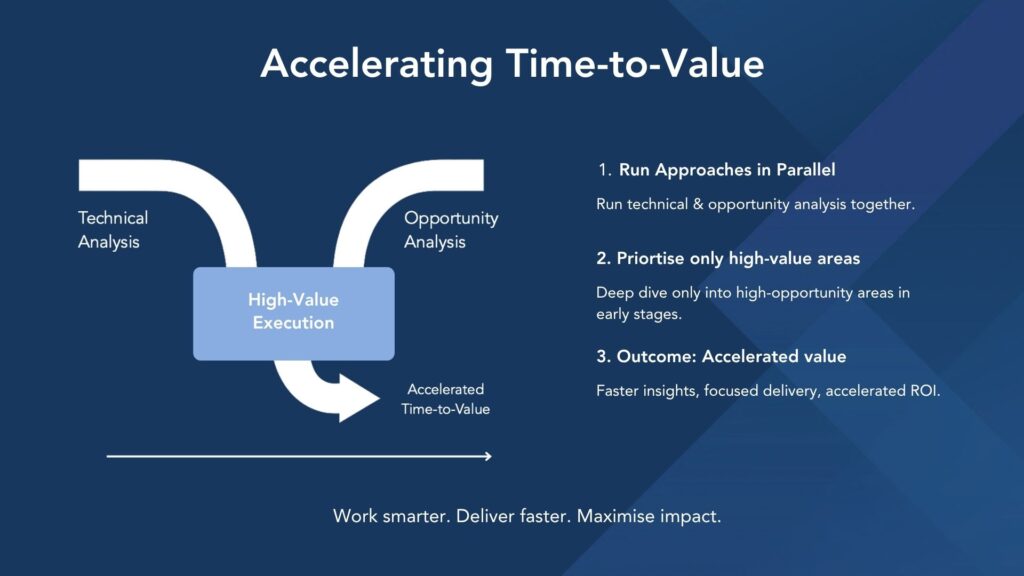
2. Run Technical Analysis and Opportunity Analysis in Parallel
One of the most important mindset shifts is abandoning the linear workflow:
Traditional SEO:
Audit → Fix → Publish → Measure
Opportunity-first SEO operates more dynamically:
Analyse → Prioritise → Execute → Measure → Accelerate
Instead of waiting for the entire audit to complete, we identify:
- which templates drive value
- which technical issues block those templates
- which pages have the fastest route to visible gains
This ensures technical SEO is value-aligned. Only pages and templates connected to commercial upside get immediate technical attention.
Everything else becomes backlog. Not a blocker.
BFSI Example
A bank avoided months of low-value blog cleanups by focusing engineering time on loan and credit card templates. Fixing CWV, indexation, and structured data for these pages alone lifted organic product applications by 30% — without touching 95% of the site.
3. Build a Commercial Business Case for Every Recommendation
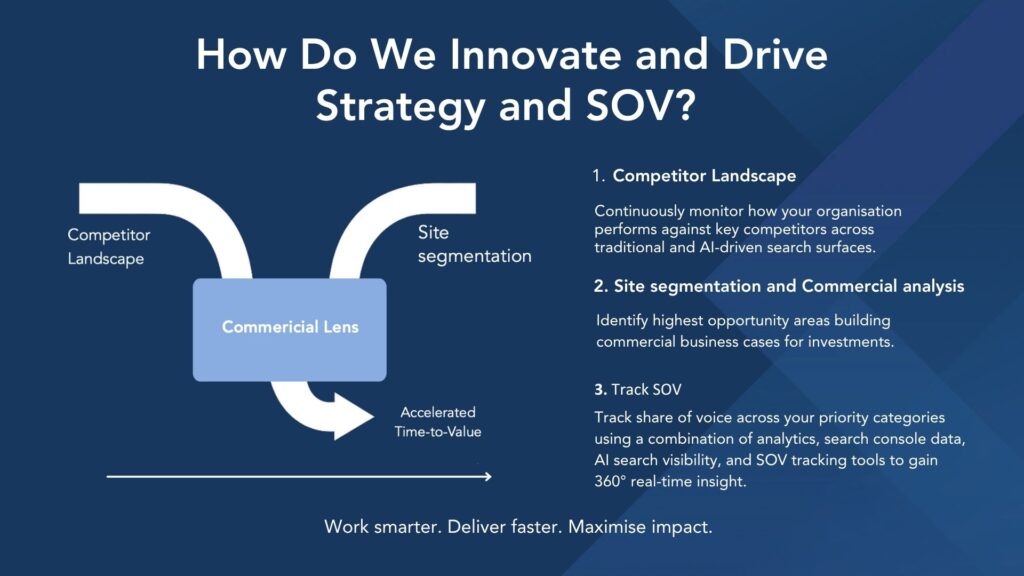
SEO stops being a cost centre when every recommendation connects to measurable commercial impact.
Opportunity-first SEO models each category using:
- search demand
- competitor gaps
- expected win share
- conversion likelihood
- AOV
- forecasted revenue
- cost of inaction
Suddenly, SEO becomes a profit engine.
For a telecom operator, this might mean modelling revenue from business internet plans or device sales.
For a bank, it means quantifying uplift from loan templates or calculators.
For a MarTech business, it ties directly into pipeline creation.
MarTech Example
For a CDP vendor, opportunity analysis showed that “alternatives to [competitor]” queries were worth more revenue than 40 lower-intent educational blogs combined. The business case was obvious — invest in comparison pages. And when they did, ARR pipeline increased in 6 weeks.
4. Iterate Fast to Accelerate Time-to-Value
One of the most overlooked advantages of an opportunity-first model is the ability to move quickly, test quickly, and refine quickly. When technical and opportunity analysis run in parallel, teams aren’t forced to wait for a perfect picture before acting. They can publish, measure, adjust, and improve in tight cycles.
This iterative agility compounds. Rather than waiting months to see if a change was effective, opportunity-first SEO supports:
- rapid experimentation across templates and content
- quick validation of messaging, structure, and schema
- early identification of what resonates in AI-driven search
- continuous refinement that compounds visibility
In an environment where organic traffic is tightening and relevance can decay in weeks, not months, iteration becomes a competitive advantage. Teams that can learn faster, adjust faster, and redeploy faster will naturally outperform those locked into long, sequential roadmaps.
Opportunity-first SEO accelerates time-to-value not only by prioritising high-impact work, but by enabling continuous optimisation that multiplies impact over time.
5. Execute Only High-Impact Work That Accelerates Visibility
This is where the operating model completely changes.
Instead of doing everything, we do only what moves the needle:
Examples of high-impact actions:
- Creating landing pages for stocked brands to capture non-branded intent
- Building plan comparison hubs
- Optimising Core Web Vitals only on priority templates
- Deploying structured data for products, reviews, plans
- Building entity signals for brand, products, services
- Improving bilingual/multilingual content coverage
- focusing link acquisition efforts around commercial pages
- improving city-level store visibility
- resolving canonical issues only where they limit value
This is precision SEO, not volume SEO. The 20% of effort that drives 80% of growth.
6. Build Authority Where It Matters Most
Authority is not won site-wide – it is won topic-by-topic. In most industries, authority dynamics follow clear patterns:
- competitors publish faster or more often
- link equity erodes over time
- topical gaps weaken trust
- brand mentions remain unclaimed
- PR momentum fluctuates
Opportunity-first SEO strengthens authority selectively, investing only in themes and clusters where authority will translate directly to commercial impact.
This is how brands build ranking resilience that compounds over time.
Why Opportunity-First SEO Aligns Better With 2025–2030 Search
The next five years will bring profound changes to search visibility. Four shifts make the opportunity-first model not only effective, but essential.
Audit-first SEO is slow by design. Opportunity-first SEO is engineered for speed.
The Bottom Line
Companies don’t win by fixing everything. They win by prioritising what actually creates growth.
Opportunity-first SEO is:
- prioritising the categories that drive revenue
- capturing demand earlier in the user journey
- building authority in topics competitors ignore
- strengthening structured data and entity signals
- accelerating visibility at speed
- aligning SEO with acquisition, retention and growth
- investing where impact compounds
Traditional SEO cleans.
Opportunity-first SEO competes.
Brands that embrace this model will lead the next decade of organic growth.
Brands that don’t will spend years optimising pages that never had the potential to move the needle, while their competitors accelerate past them.
Download Our AI Search Checklist
Get the AI Search Checklist and find out what’s holding back your visibility — and where to optimise first.
About The Author

Charlie Nicholls