contact centre cdp use cases

Why Contact Centers Are the Next Frontier for CDPs

contact centre cdp use cases


In today’s rapidly evolving digital landscape, companies are increasingly turning to customer data platforms (CDPs) as a foundational element for innovation, personalisation, and operational efficiency within their Martech architecture. A CDP’s ability to unify customer data from multiple sources, including traditional, behavioural, and engagement channels, provides organisations with a single source of truth that enables them to understand and predict customer needs in real time. Further to this, by combining CDPs with AI, brands can achieve a new level of predictiveness, personalisation, and automation across marketing, sales, and service capabilities that were previously not attainable.
 
With CDPs supporting a wide range of strategic initiatives across various business units, realising value from your CDP investment requires a measured approach to use case identification, definition, and prioritisation. This provides a strategic framework that delivers value incrementally through a value-based prioritisation roadmap.

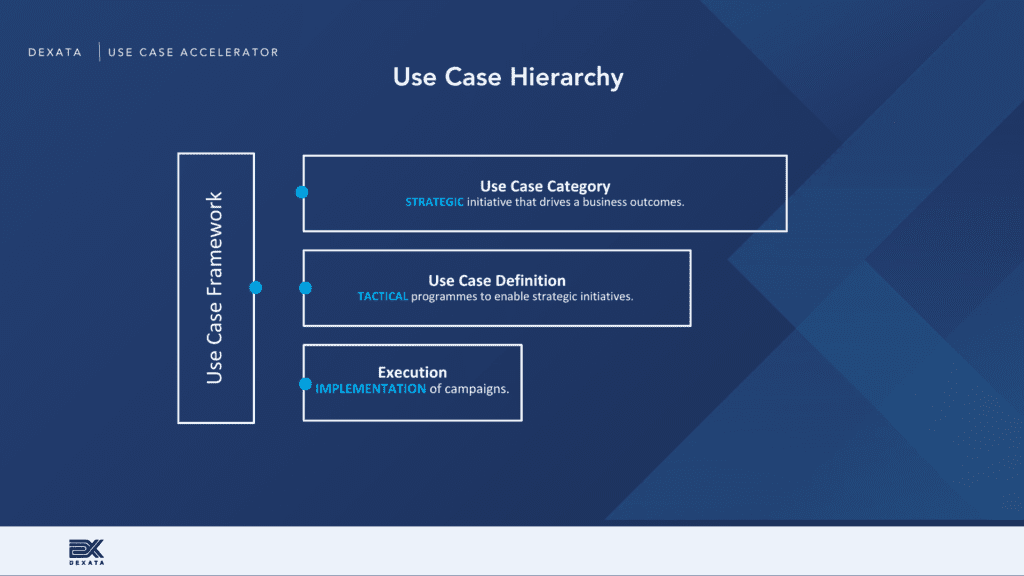
USE CASE FRAMEWORK

To drive meaningful and repeatable value from a CDP, organisations benefit from structuring their initiatives within a clear, hierarchical Use Case Framework. This framework ensures that every CDP investment, whether strategic or technical, can be traced back to a measurable business outcome. It also helps teams prioritise, coordinate, and operationalise use cases across marketing, sales, service and analytics.

1. 1 USE CASE CATEGORY ( STRATEGIC LEVEL)

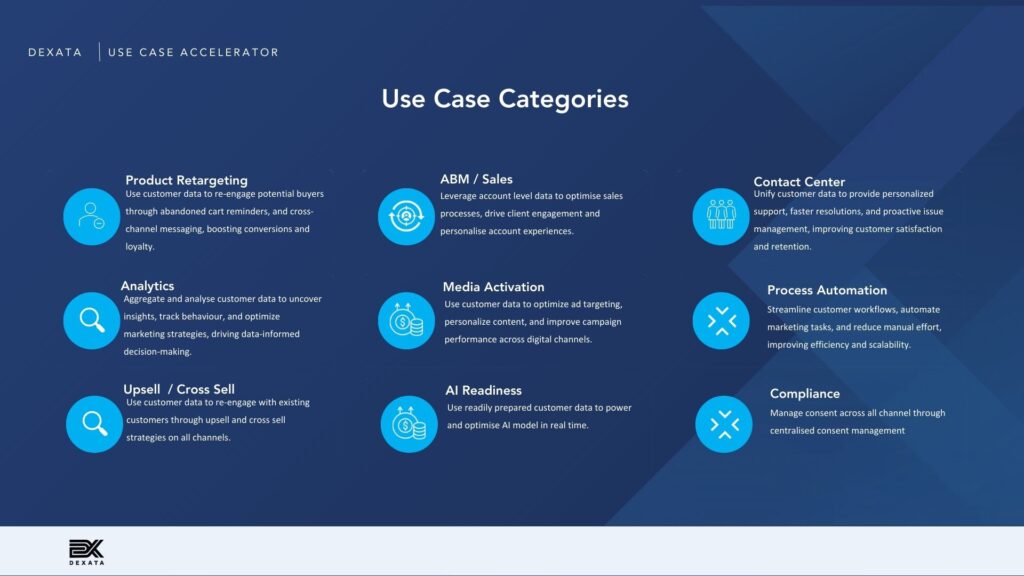
This represents the highest-level business objective the organisation is solving for, for example, personalisation, analytics, contact center optimisation, or process automation. Categories provide strategic clarity and help stakeholders align CDP initiatives with organisational priorities.

2. USE CASE DEFINITION ( TACTICAL LEVEL)

Within each category, specific use cases define the tactical initiatives that bring the strategy to life. These are discrete, measurable activities, for example, powering next best action guidance in the contact center, suppressing unhappy customers from marketing communications, or enabling real-time web page personalisation. Use case definitions describe what the organisation wants to do and why it matters.

3. USE CASE DEFINITION ( EXECUTIONAL LEVEL)

At the foundation of the framework is execution: the data, integrations, identity resolution, decision logic, and activation points required to enable the use case. This level translates business intent into technical implementation, detailing how the use case will be operationalised within the CDP and connected systems.

USE CASE CATEGORY - CONTACT CENTER

The following sections will explore how CDP capabilities translate into increased improvements in agent effectiveness, operational efficiency, and customer experience within the contact center environment.
 
Advancements in technology have transformed contact centers from purely service-oriented functions into powerful sales channels. With real-time customer data, AI-driven insights, and integrated communication platforms, agents can now identify intent, personalise conversations, and present relevant offers during live interactions. CDPs are at the centre of this transformation, connecting the dots between multiple systems.

CONTACT CENTER - USE CASE DEFINITIONS

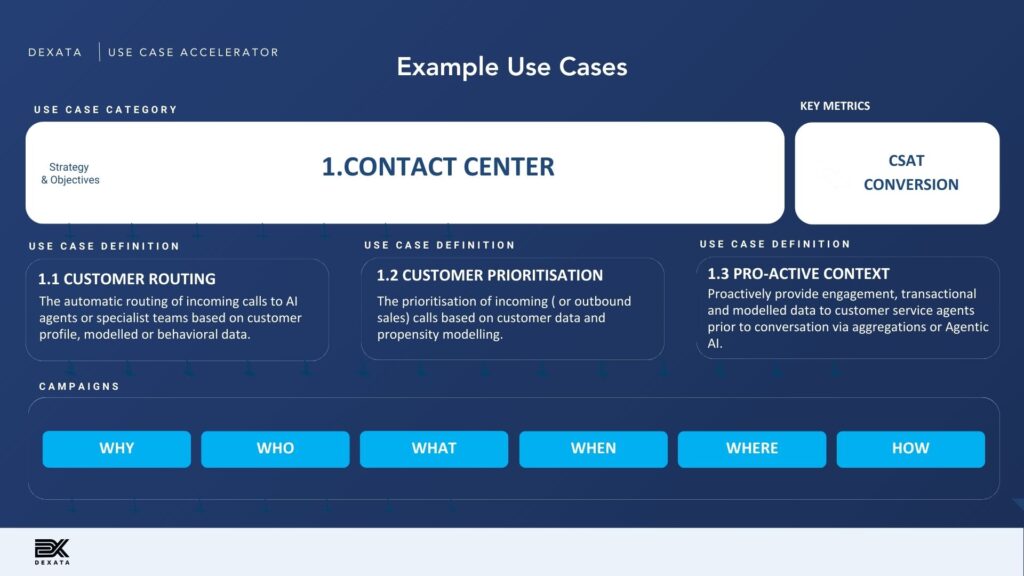
1.1 CUSTOMER ROUTING

Customer routing is a foundational use case for CDPs in modern contact centres. By unifying first-party customer profile data with real-time behavioural, transactional, and modelled insights, a CDP enables the automatic routing of incoming interactions to the most appropriate AI agent or human specialist team. Rather than relying solely on IVR menu selections or static business rules, CDPs dynamically evaluate factors such as customer value, product purchases, lifecycle stage, recent digital activity, risk indicators, and predicted intent.
 
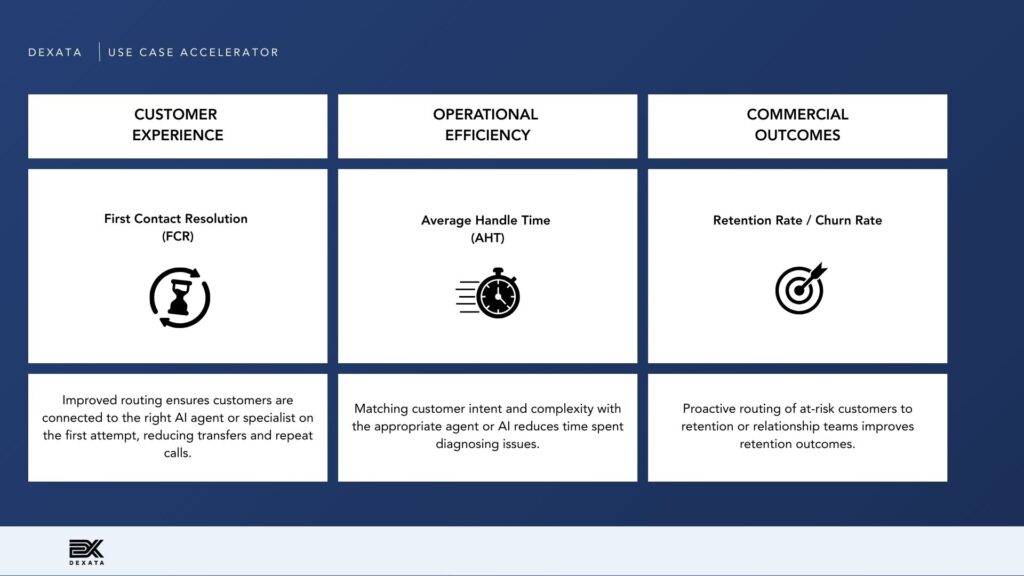
This results in faster resolution, improved customer experience, and more efficient utilisation of contact centre resources, while ensuring that high-value or high-risk interactions are handled with appropriate expertise.


INDUSTRY EXAMPLE
 
A retail bank uses a CDP to integrate customer data from its core banking systems, mobile and online banking behaviour, CRM records and predictive models such as propensity to churn or buy, with its contact centre.
 
When a customer calls the contact centre, the CDP identifies them in real time and enriches the interaction with insights including:
  • high net worth status
  • recent failed digital loan application
  • elevated churn risk.
Based on this profile, the call is automatically routed past a general service queue to a senior relationship manager or a specialised lending support team.

VALUE REALISATION

1.2 REAL TIME PRIORITISATION

CDPs enable outbound contact centre operations to prioritise sales and retention calls based on a customer’s predicted likelihood to churn and propensity to buy. By combining unified customer profiles with behavioural signals and predictive model outputs, the CDP continuously scores and ranks customers in the outbound queue according to urgency and potential value.
 
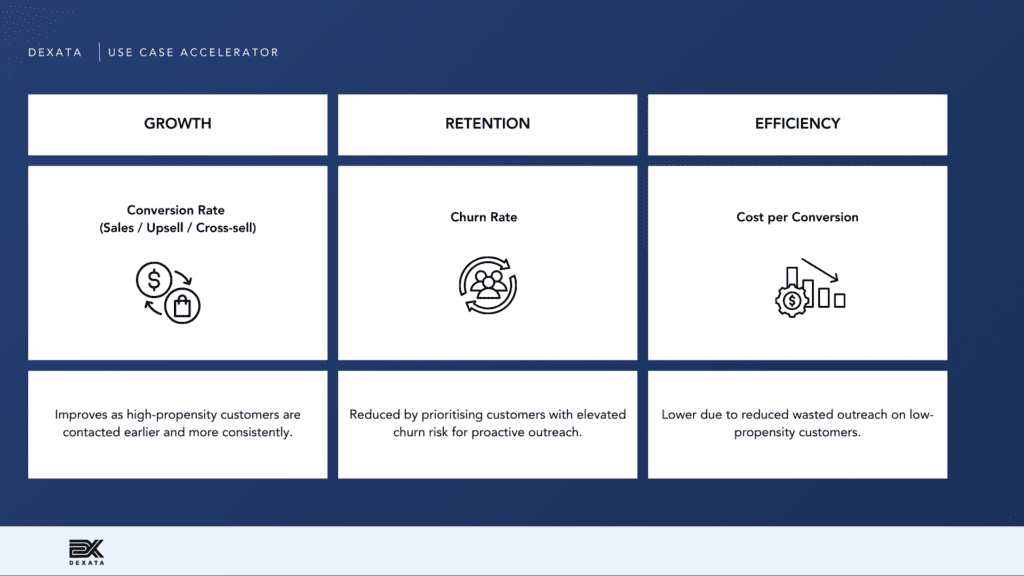
Customers with a high risk of churn or a high probability of purchase can be elevated in priority and contacted by the most appropriate sales or retention agents, while lower-priority customers are deferred or handled through lower-cost digital channels. This data-driven prioritisation ensures outbound capacity is focused on interactions with the greatest commercial and retention impact, improving conversion rates, reducing churn, and optimizing contact centre efficiency.
INDUSTRY EXAMPLE
 
A telco provider uses a CDP to unify customer data from billing systems, network usage records, mobile app behaviour, CRM, and customer care interactions.
 
The CDP applies predictive models to calculate each customer’s propensity to churn, in consideration of indicators such as repeated network issues, declining usage, late payments, or recent complaints.
 
Similarly, it applies predictive models to calculate propensity to buy, informed by device upgrade eligibility, data consumption growth, and recent visits to plan comparison or upgrade pages.
 
These scores are used to dynamically prioritise the outbound call queue. Customers with high churn risk and high propensity to buy are prioritised at the top of the call queue and assigned to experienced retention or sales agents who are authorised to offer tailored incentives, such as discounted 5G plans, device upgrades, or loyalty bundles. Customers with high churn risk but low purchase propensity are assigned to retention specialists focused on service recovery, while customers with low churn risk and moderate propensity to buy are scheduled for later outreach or targeted through digital campaigns.
 
By prioritising outbound calls based on CDP-driven churn and purchase propensity, the telco can improve retention rates, increase upgrade conversions, and ensure outbound sales resources are focused on customers where timely, contextual engagement delivers the greatest impact.

VALUE REALISATION

1.3 PRO ACTIVE AGENT ENRICHMENT

CDPs hold a wealth of customer information that, when surfaced to agents, can provide valuable context for a customer and their query. Engagement history, transactional data, behavioural signals, and predictive model outputs (e.g., churn risk, propensity to buy) can be utilised to deliver a unified, actionable view to contact center agents before or during customer interactions.

This can be presented via dashboards, CRM integrations, or even conversational AI assistants (“Agentic AI”) that suggest next-best actions, recommended offers, or conversation scripts.

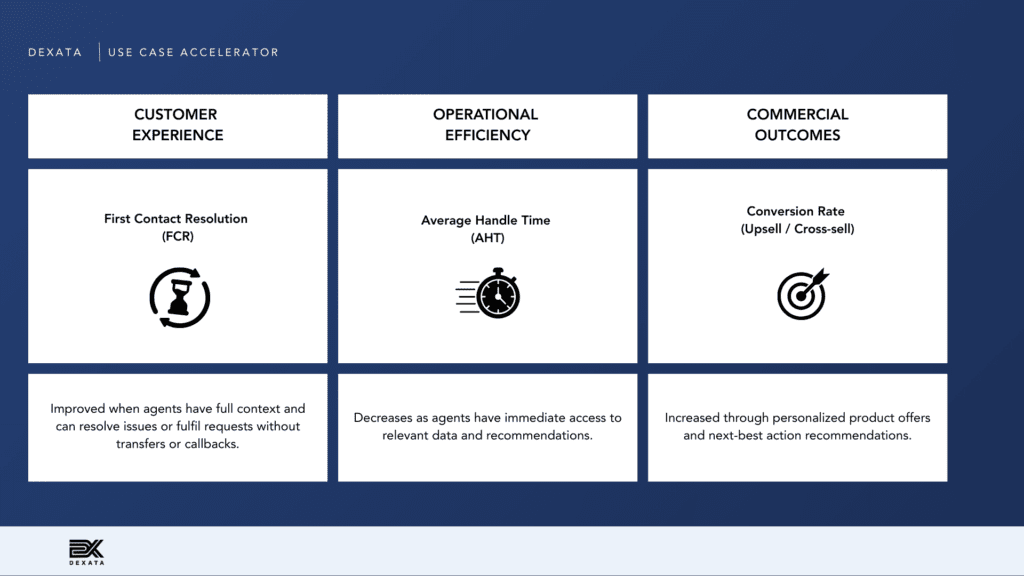
By providing agents with rich context upfront, the CDP improves first-call resolution, reduces average handling time, and increases both sales and retention effectiveness.

INDUSTRY EXAMPLE

A banking contact centre uses a CDP to deliver to agents, in real time, the customer’s recent online banking activity, pending loan application status, and predictive churn score. When the customer calls, the agent sees suggested next-best actions, for instance, a proactive loan offer, personalised account advice, or retention offers. This allows them to handle the call efficiently and with a tailored, personalised, and valuable experience.

VALUE REALISATION

Whilst the use cases described cover the most impactful contact centre use cases, CDPs support a wide range of other contact centre applications. For example, sentiment tracking, escalation, and self-service deflection. By unifying and operationalising customer data across behavioural, transactional, and modelled signals, organisations can simultaneously reduce the cost of their contact centre operations whilst increasing revenue. By integrating your CDP with your contact centre, business value is ultimately realised through optimising agent and interaction performance through effective, timely, and relevant conversations.

About The Author

Picture of Alexander Glanville-Wallis
Alexander Glanville-Wallis
Head of Marketing Technology @ Dexata
Connect with ALEX
Leave a Reply

Your email address will not be published. Required fields are marked *

top
Adobe

Adobe Analytics
Adobe Target
Adobe Audience Manager
Adobe Experience Manager
Adobe Campaign Manager
Adobe Real-Time CDP

Google

Google Analytics (GA4)
Google Analytics (360)
Google Optimize
Google Tag Manager

Tealium

Tealium AudienceStream CDP
Tealium EventStream
Tealium IQ

Segment
Quantum Metric
MoEngage
CleverTap
MixPanel
OneTrust
Playrcart
VWO
Optimizely