



From Experiments to Intelligent Systems
Entering MarTech, I learned that personalisation is often discussed as a feature or capability: run an experiment, personalise a page, optimise a journey.
Working more closely with Adobe personalisation, that view began to shift.
From a data science perspective, personalisation is not a feature.
It is a system.
And Adobe’s ecosystem makes that especially clear.
From Tools to Systems: A Second-Month Reflection
Early on at Dexata, one idea became clear:
MarTech is not about tools. It is about value.
As I deepened my exposure to Adobe personalisation, that idea was reinforced through a more technical, data-oriented lens.
Adobe Target is often described as an experimentation or personalisation platform. What surprised me was how strongly it behaves like a decisioning layer, sitting downstream of data collection and upstream of customer experience.
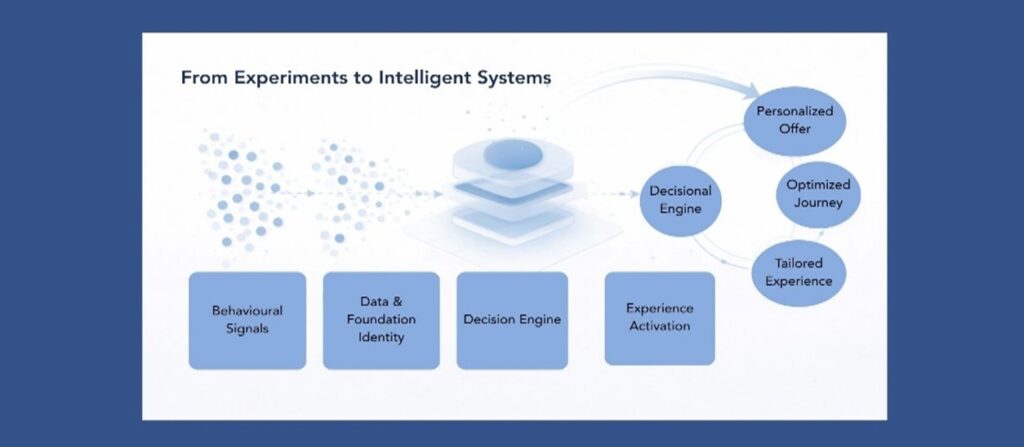
Personalisation outcomes depend far less on the tool itself than on:
- the quality of signals entering it,
- the governance applied to those signals,
- and the way decisions are validated and scaled.
From a data science perspective, this framing matters.
Seeing Adobe Target as a Decisioning Engine
Looking at Adobe personalisation through a data science lens reframes many familiar concept:
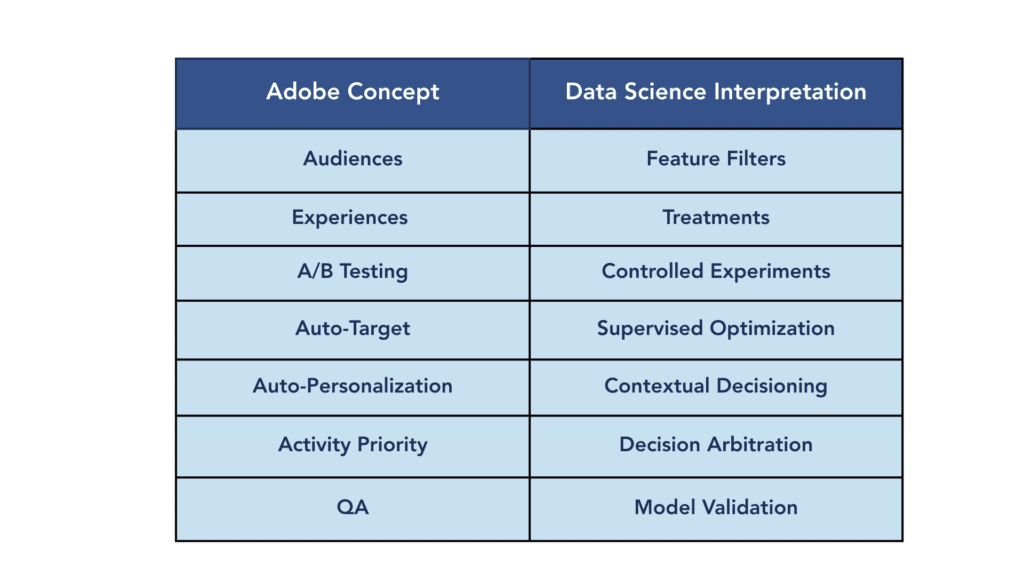
Rather than asking “Which experience should we show?”, the system is constantly answering a deeper question:
“Given what we know right now, what decision creates the most value?”
 This shift in thinking helped me better understand why governance, QA, and data quality matter so much as personalisation becomes more automated.
For teams scaling personalisation, this shift in thinking matters more than any single feature.
Why Data Foundations Matter More Than Algorithms
Auto-Target and Auto-Personalization are often described as “AI features”. In reality, their effectiveness depends entirely on what feeds into them.
Seeing how Adobe Target is used in real-world personalisation workflows makes this especially clear.
From my exposure across GA4 analysis, CDP foundations, and behavioural validation, one pattern appears repeatedly:
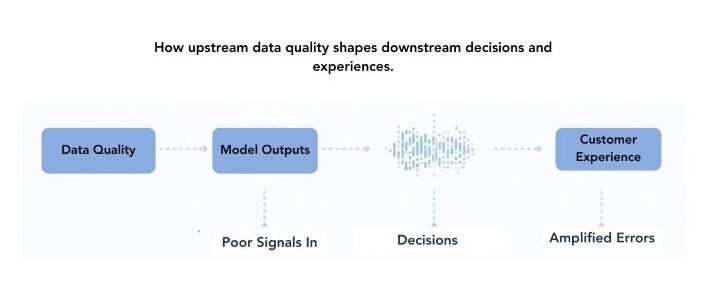
When data is inconsistent, incomplete, or poorly governed, optimisation does not just slows down it optimises the wrong thing.
In interconnected MarTech stacks, small issues rarely stay isolated:
- mislabelled events change behavioural narratives,
- missing consent affects activation,
- identity mismatches distort learning loops,
- weak QA introduces silent bias into models.
AI does not remove these risks.
It amplifies them.
Where Adobe Fits in a Modern MarTech Stack
One of the most useful mental models I have developed is thinking in layers, not tools.
Rather than comparing platforms, it is more productive to understand their roles:
- Analytics (e.g. GA4, BigQuery) – observing behaviour
- Data & identity platforms (CDPs) – structuring, governing, and connecting signals
- Decisioning platforms (Adobe Target) – choosing actions
- Experimentation tools – learning what works
- Automation & orchestration – scaling decisions responsibly
Personalisation value emerges between these layers, not inside any single one.
Adobe Target becomes most powerful when it operates as part of a connected system, not as a standalone optimisation tool.
Governance and QA: Foundations for Safe, Scalable Personalisation
As personalisation moves from manual rules to machine-driven optimisation, the cost of errors increases.
From a data perspective, QA is not just about preventing broken experiences.
It is about controlling decision risk.
Unchecked automation can:
- reinforce hidden biases,
- apply incorrect treatments at scale,
- create inconsistent customer experiences,
- undermine trust before teams realise something is wrong.
What became evident to me is how much of mature Adobe personalisation depends on discipline, not speed:
- validating decision logic,
- understanding priority conflicts,
- ensuring experiences behave as expected across environments.
This operational maturity is what allows experimentation and AI to scale safely.
From Experiments to Agentic Optimisation
Auto-Target and Auto-Personalization are not new. They have existed for years. However, seeing them through a data science lens, they represent an early form of agentic behaviour:
- the system observes,
- decides,
- learns,
- and adapts with minimal human intervention.
For me, this is where MarTech becomes an applied AI problem: designing decision systems that can learn, adapt, and scale while remaining observable, governed, and trustworthy.
What excites me most is not the automation itself, but the question it raises:
How do we govern, monitor, and trust intelligent systems at scale?
This question connects experimentation, personalisation, automation, and AI into a single trajectory, one I am increasingly interested in exploring as my role evolves.
What This Month Changed for Me
In my second month at Dexata, Adobe personalisation helped me see MarTech less as a collection of platforms and more as a living system shaped by data quality, governance, and execution discipline.
It reinforced a simple, yet powerful lesson:
Intelligent experiences do not start with AI.
They start with trusted data and thoughtful systems.
As I continue my internship, I am excited to keep learning how experimentation, personalisation, automation, and AI come together to create measurable customer value responsibly and at scale.
One month later, the idea still holds true:
MarTech is not about tools.
It is about building better experiences for people.

