

The Fellowship of CDP: Cross-Functional Collaboration for successful CDP programmes
A few weeks back, while hosting an event organised by MarTech London Meetup, I referred to The Lord of the Rings and asked the attendees who did they think as the hero of this iconic trilogy. I got usual answer “Frodo” but one person said what I expected – “all of them!”. And they hit the nail right on the head. Can you really name just one hero in a saga which is an epitome of teamwork? Could Frodo have made it to Mount Doom without Gandalf’s wisdom, the Elves’ support, Sam’s loyalty, or the sheer strength of the entire Fellowship? No way! Their victory over Sauron wasn’t about a single person; it was about teamwork and a shared, unshakeable commitment to one vital goal.
Getting a successful Customer Data Platform (CDP) programme off the ground is a quest just as epic and complex, as defeating Sauron. It’s all about creating that unified customer profile, and you can’t do it alone. It demands building a strong foundation of collaboration across every function in your organisation. In this article, I’ll dive into the different teams, what they’re responsible for, and show you exactly how they fit the mould of their very own Lord of the Rings Fellowship!
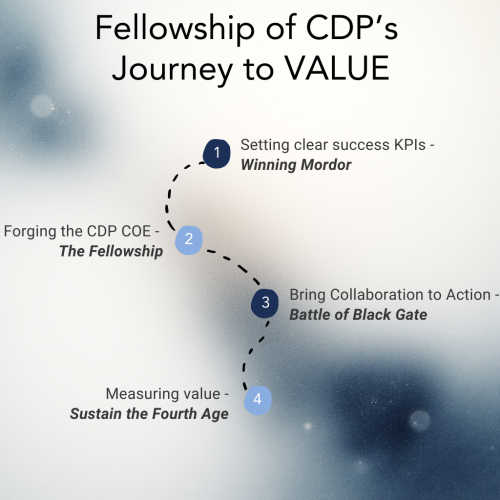
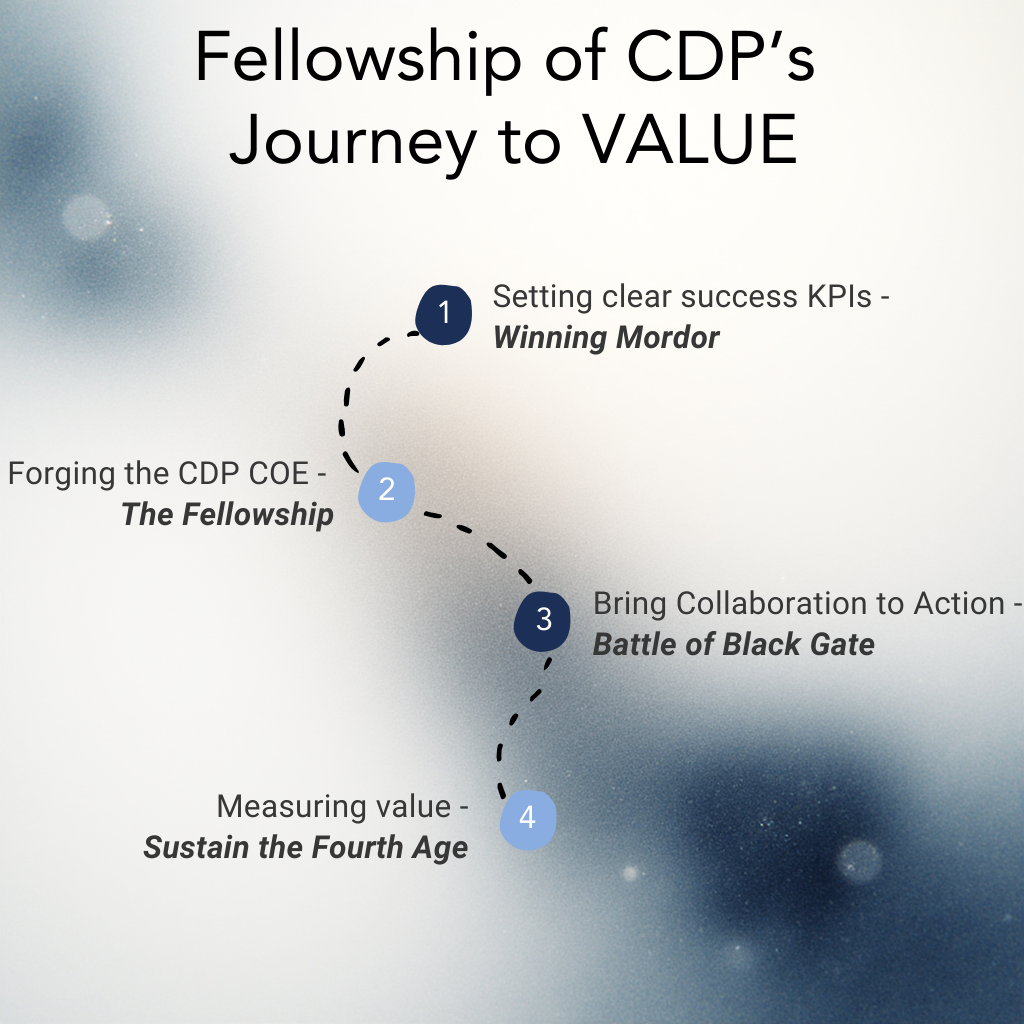
The Quest for the Unified Customer Profile: Setting the Stage for Collaboration
There are several studies that talk about the benefits of personalisation and CDPs are a key enabler to achieve that goal. Fundamentally, a CDP is a specialised technology designed to centralise and unify customer data drawn from disparate channels, systems, and data streams, including digital behavioural data (web and mobile apps), CRM systems, marketing platforms, service software, and e-commerce engines to construct an enriched profile (you see I don’t use the term 360 degree view of customer here as its a myth that marketers should stop running after).
However, defining the CDP merely as a technological tool misses its true strategic value. While it provides a central database for user-level data, the CDP’s ultimate function is to serve as an enabler of better decision-making and operational efficiency. Its success is measured not by its technical integration but by its capacity to help business teams execute core P&L objectives, such as optimising acquisition costs, improving conversion rates, and enhancing customer retention. The focus must therefore be immediately directed away from platform features and toward clearly articulated, measurable business.
The Great Threat: Organisational Silos as the Enemy (Mordor)
According to a recent McKenzie report on MarTech’s value realisation, lack of executive sponsorship and organisational silos are top reasons why CDP programmes fail. The core inhibitor to realising CDP value is the persistence of organisational silos. These self-contained departments operate independently, often establishing separate goals, distinct objectives, and isolated communication channels. When departments operate in isolation, they create inconsistencies, duplicate efforts, and prevent cross-functional collaboration, which is the necessary prerequisite for achieving a unified customer view.
This friction forces the recognition that a CDP programme must be approached first and foremost as a program of organisational restructuring and cultural transformation, and only secondarily as a technology deployment. Since the platform forces data democratisation, it inherently challenges existing internal power structures. Success demands that these silos be proactively dissolved, substituting independent action with mutual cooperation guided by shared goals and bi-directional communication.
Defining the Goal (Destroying the Ring): Linking CDP Capabilities to High-Value Objectives
The Council of Elrond: Forging the Customer Data CoE
To achieve the necessary cross-functional alignment and overcome systemic silos, organisations must establish a formal governing structure, typically referred to as a Customer Data CoE. This CoE serves as the central hub for the CDP program, embodying the required “team approach” to unify internal staff and external partners around shared objectives.
The establishment of a successful CoE involves four critical steps:
- adopting a team approach;
- establishing detailed processes;
- adopting technology to empower people and processes;
- and immediately focusing on generating demonstrable value.
Crucially, the CoE must formalise its governance by assigning clear ownership to every step of the process, identifying key handoff points between functional teams, and enacting definite rules for communication to eliminate ambiguity and conflict.
The Mandate of the King: Executive Buy-in and Sponsorship
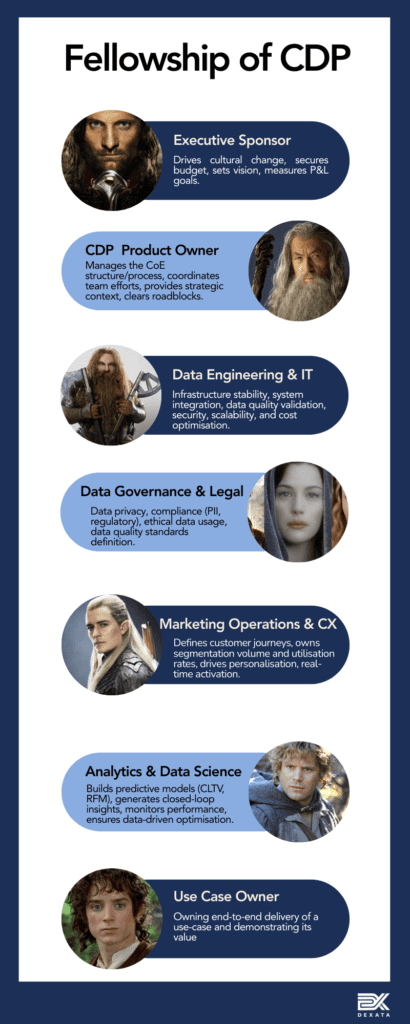
The viability and sustained success of the CoE hinge entirely on securing full commitment from C-Suite and Executive Leaders. This Executive Sponsor plays the role of the King (Aragorn), the Uniter. Aragorn’s leadership, characterised by humility, genuine care for his subordinates, and the ability to lead from the front, mirrors the necessary characteristics for a transformative executive. The Executive Sponsor must provide the foundational strategic direction, ensure the CoE remains aligned with overarching business goals, and secure the substantial capital investment required for CDP implementation and maintenance.
The executive leader is instrumental in driving the cultural shift necessary for transformation. They provide the moral and operational authority to compel disparate departments to collaborate, demonstrating the commitment needed to break down power structures based on data isolation.
Refer to this article by Darwin CX on some tips for getting sponsorship of your Aragorn.
The Scepter of Power: Sustaining Investment through Value Demonstration
For the Executive Sponsor’s support to remain robust, the CoE must consistently translate technical achievements into the language of senior leadership: return on investment (ROI), reduced churn rates, increased ad sales, and improved customer retention. Since CDP programs demand intensive capital investment , sustained C-suite endorsement is directly dependent upon demonstrable success against these key strategic metrics.
The CDP Program Manager must, therefore, become adept at strategic communication, scheduling regular check-ins with executives prepared with data and insights that showcase the program’s impact on their specific areas of responsibility. By quantifying the program’s value using a value chain approach and presenting the resulting data in business terms, the CoE can solidify its strategic importance, ensuring the resources needed to continue the journey are maintained.
The Fellowship of the CDP
The CDP initiative is a complex, high-stakes journey that requires a dedicated, specialised, and highly interdependent team. Like the Fellowship of the Ring – composed of heroes representing various races and skills unified by a single, momentous goal, the CDP COE must pool expertise from every corner of the organisation. Each member of the “Fellowship of the CDP” brings a unique, non-negotiable strength essential for the completion of the program.
The Specialised Roles and Interdependencies
The CDP Program Manager (Gandalf) is the Central Coordinator, providing the strategic context, giving clear instructions, collecting necessary information, and ensuring alignment between the technical and business objectives. This role is vital for clearing internal obstructions and ensuring the journey remains on track.
The Data Engineering & IT Team (Gimli) are the Builders. CDPs are infrastructural tools, and IT participation is essential for setup, integration with existing systems, data security, and ensuring necessary scalability. Their domain knowledge and technical expertise ensure the stability of the foundation.
The Data Governance & Legal Team (The Elves) represent the Guardians of Ancient Law. They are responsible for managing data quality, ensuring regulatory compliance (e.g., PII protection), and establishing the ethical standards for data usage. The Elves must work tightly with IT (Gimli) to embed compliance rules at the earliest stages of data ingestion, safeguarding the entire program.
The Marketing Operations & CX Team (Legolas) is the Activation Expert, representing speed and precision. They utilise the platform to define customer journeys, create audience segments, and drive personalisation initiatives, focusing on metrics like segment utilisation volume and campaign activation velocity.
The Analytics and Data Science Team (Sam) acts as the source of Actionable Data. They leverage the rich, unified behavioural data to build advanced models, such as predictive CLTV or churn analysis, enhancing data accuracy by utilising comprehensive data sets like call transcripts and social media activity. Sam must maintain a closed-loop relationship with Marketing (Legolas), providing data-driven insights that continuously refine campaigns and personalisation efforts.
Finally, the Primary Use Case Owner (Frodo) is the individual or team tasked with bearing the specific, measurable burden, the single, most critical objective that justifies the entire program’s existence. While the goal is broad, Frodo must focus relentlessly on delivering the initial, prioritised value lift (e.g., retention improvement), relying on the support and execution capabilities of the rest of the Fellowship.
Collaboration in Action: The Stages of the Journey
The success of the COE is demonstrated through seamless collaboration across the three primary phases of the CDP journey: data ingestion, strategic use case modelling, and real-time activation. Failure points commonly emerge when the necessary handoffs and mutual understandings between teams are not formalised.
Each of the stages below is worth a book in itself so will cover these at just high-level here:
- This is where Data Engineering/IT (Gimli) and Data Governance (Elves) establish the foundational technology and privacy standards.
- The "Moria Moment" is the conflict between IT's cost concerns with federated data and Marketing's need for real-time activation.
- IT and Marketing must collaboratively negotiate which data is copied into the CDP to enable low-latency functionality without compromising financial viability. <
- The CDP Product Owner (Gandalf) guides the effort, ensuring the Use Case Owner (Frodo) remains focused on defined business outcomes.
- Marketing (Legolas) defines the goals and KPIs, while Data Science (Sam) builds and refines predictive models.
- This collaboration ensures high-accuracy insights directly inform campaign execution, establishing the foundation for continuous improvement.
- This final stage enables all front-line teams (Sales, Service, Marketing) to use the unified data in real-time.
- Success relies heavily on operational synchronisation between IT and Marketing.
- If technical integration is complex or slow, teams revert to manual, outdated workflows, instantly negating the CDP’s real-time value proposition and leading to activation failure.
Measuring Value and Sustaining the Fourth Age: KPIs for Cohesive Success
Proof of CDP success must extend beyond technical metrics to encompass organisational health and demonstrable ROI. Since the implementation represents a major cultural shift, the measuring stick for victory is how effectively the organisation has transitioned from siloed operations to collaborative data stewardship. Research indicates that employees are often highly motivated to reduce silos ; the KPI scorecard proves that leadership has successfully channeled that motivation into measurable business value.
The cohesive KPI Scorecard tracks four interdependent categories to maintain organisational cohesion and validate investment:
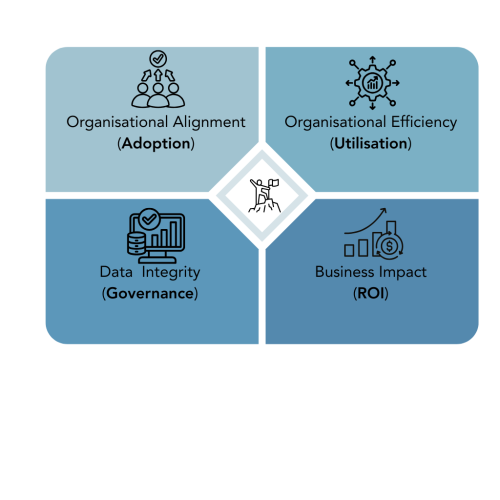
The crucial element of this scorecard is the interdependence of the metrics. A common implementation pitfall is the inability to measure ROI. This often occurs because the upstream metrics of Governance and Utilisation are weak. For example, if Data Integrity is compromised, the predictive models developed by Data Science will be inaccurate. If Utilisation (segments activated) is low, Marketing cannot effectively target campaigns. Therefore, business impact (ROI) metrics like Customer Retention Rate are entirely dependent on the operational excellence achieved through collaboration across all functions. The KPI scorecard thus functions as the institutional mechanism for continuous justification, proving that the CoE is effectively channeling the collective strength of the organisation toward strategic goals.
Click on each card for more details and example metrics for each category:
Organisational Alignment
(Adoption)
Example metrics Trainings completed, number of business units onboarded, % of teams using CDP
Operational Efficiency (Utilisation)
Example metrics Audience activation rate, Use-cases deployed, Campaigns executed
Data Integrity
(Governance)
Example metrics Data Quality Index, Compliance Audit Success rate, SLA adherence percentage
Business Impact
(ROI)
Example metrics CLTV, Customer Retention Rate, ROAS
Remember – Real life is different from the reel-life
While our Fellowship’s journey concludes with the celebratory destruction of the Ring and a happy ending for Middle-earth, the CDP quest is a much longer saga. In the movies, the heroes save the day and retire to the Shire; in real life, a successful CDP programme means the work has just begun. Proving ROI isn’t a single, dramatic moment, it’s a continuous grind of refining use cases, maintaining data quality, adjusting to new regulations, and constantly improving customer experience. Our teams can’t just disband once the platform is live; they must treat the CDP not as a destination, but as a crucial, always-on engine that requires persistent cross-functional cooperation to keep delivering measurable business value, day after day.
Conclusion
The CDP journey is a transformative quest where success is determined not by the technology, but by organisational maturity and collaborative governance.
The true enemy is the internal friction created by silos. Conquering them requires an empowered Executive Sponsor (Gandalf) leading a Center of Excellence and enforcing a cultural shift toward shared data ownership.
Every specialist – from Engineers (Sam) building the foundation to Marketers (Aragorn) driving activation must operate as one Fellowship. When collaboration fails, the CDP fails. The technology is just the tool; the true, profitable future lies in dissolving departmental barriers and maintaining that persistent cross-functional alignment. This commitment to cross-functional alignment transforms the organisation, ensuring the Fourth Age of data-driven customer centricity is sustained and profitable.
About The Authors

Rajneesh Gautam