



Most MarTech audits end the same way: a spreadsheet, a list of underutilised tools, and a set of recommendations in a PowerPoint that never quite make it into the roadmap.
That’s not an audit problem. It’s a design problem. An audit is only as valuable as the decisions it enables. And most audits are designed to document the technology stack, not to assess how effectively people, processes, and technology are working together to create value from it. They tell you what platforms you own. They rarely tell you whether teams are equipped to use them effectively, whether operational processes support adoption and scale, what the technology is actually delivering, or how to make the case for change at board level.
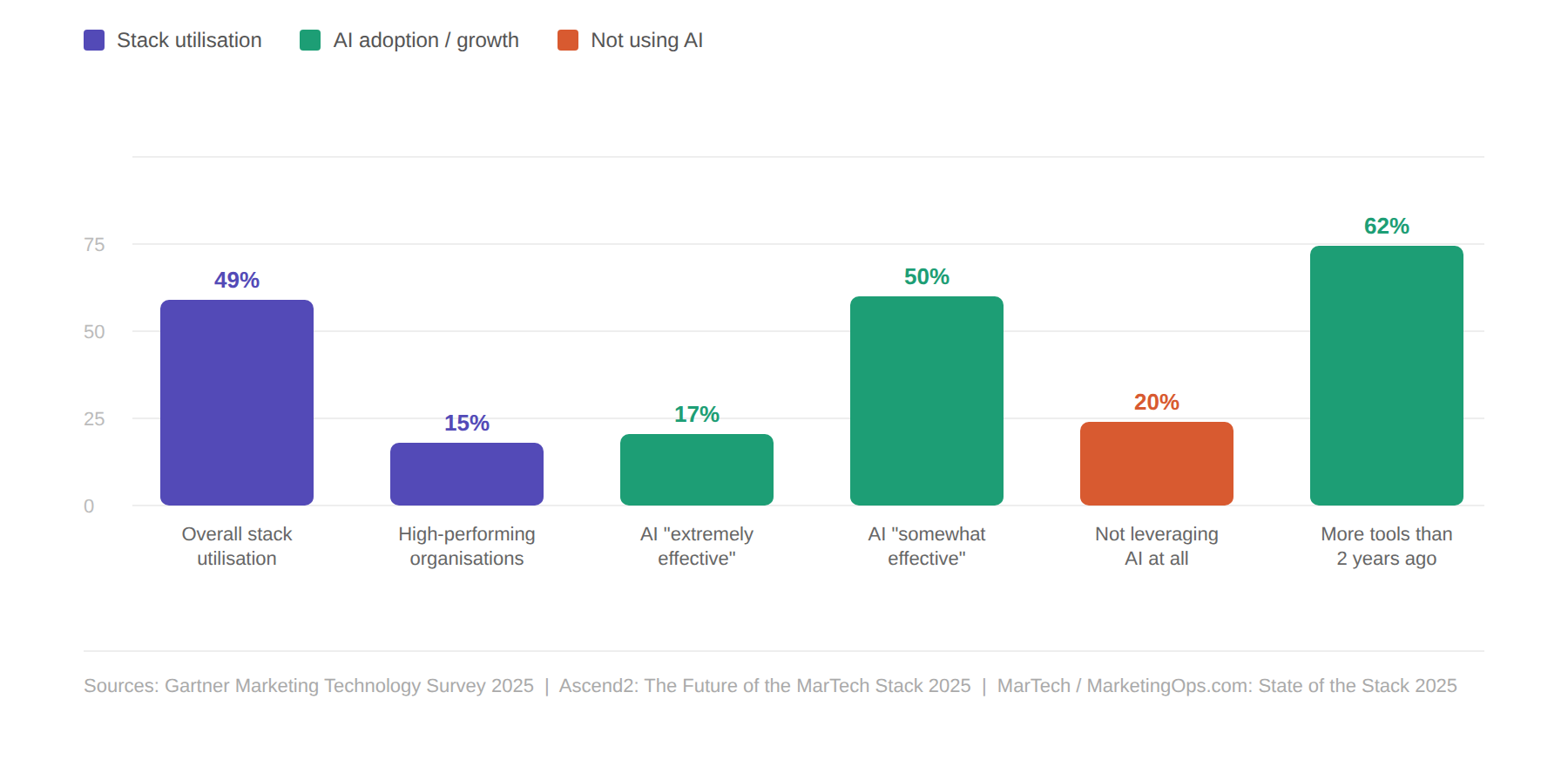
As we explored in our article on MarTech Value Engineering, one of the biggest challenges facing enterprises is not access to technology, but the inability to fully realise the value already sitting within the stack, and to prioritise the people, process, and technology changes required to unlock that value faster. The numbers support this. According to Gartner’s 2025 Marketing Technology Survey, MarTech utilisation has dropped to just 49%, meaning roughly half of what organisations are paying for is sitting idle. Only 15% of organisations qualify as high performers: those that both meet strategic goals and demonstrate positive ROI from their stack.
Meanwhile, the landscape continues to expand. Chiefmartec’s 2025 Landscape catalogued 15,384 commercial MarTech solutions, up 9% year-on-year. And according to Gartner’s 2025 CMO Spend Survey, MarTech now accounts for 22% of total marketing budgets, making it the single largest line item. With marketing budgets flatlined at 7.7% of company revenue and 59% of CMOs reporting they do not have enough budget to execute their strategies, the pressure to demonstrate measurable return from existing investment across people, process, and technology has never been higher.
The MarTech audit is where that reckoning begins, but only if you run it properly. And in 2026, that means running it against a very different backdrop, one where the industry is actively debating the death of the MarTech stack itself. Analysts, vendors, and practitioners from Scott Brinker to Salesforce’s Martin Kihn are arguing that the “stack” as an organising idea has run its course, a view developed further by Jonathan Mendez, who argues the organising idea is no longer the stack but the data layer beneath it. The audit is where that strategic shift becomes practical: not just “what are we spending?”, but “are we architected to generate real value from what we have?”
The MarTech Utilisation Gap – Key Statistics
How organisations are actually using their MarTech stack and capabilities.
Why Most MarTech Audits Fail to Drive Change
The traditional MarTech audit is an inventory exercise. It catalogues tools, maps ownership, flags overlaps, and produces a gap analysis. Useful, but insufficient.
Three structural flaws prevent most audits from delivering lasting value.
This matters more than ever in 2026. Every major MarTech vendor, including Salesforce, HubSpot, and Adobe, has significantly expanded its AI capabilities over the past 18 months. Auditing platforms without assessing whether teams are operationally equipped and mature enough to activate and scale those capabilities is like auditing a car fleet without checking whether anyone knows how to drive, maintain, or operate the vehicles effectively. But there is a deeper issue: most AI features in MarTech platforms require clean, unified customer data to function meaningfully. If that data is fragmented across point solutions with loyalty data in one place, behavioural data in another, transactional data somewhere else, activation is largely performative. The audit must therefore assess not just whether AI features are switched on, but whether the data infrastructure exists to power them.
The framing shift is not cosmetic. It is the difference between a finding that gets actioned and one that gets filed.
The antidote is an audit designed from the outset around value realisation, not just inventory.
Table: The Structural Flaws
More detail on the three structural flaws that prevent audits from identifying where to drive lasting value
| THE FLAW | WHAT IT LOOKS LIKE | THE SYMPTOM | THE FIX |
|---|---|---|---|
01 Breadth over depth |
The audit inventories tools and licences but fails to assess utilisation depth, including how extensively platforms are being adopted across workflows, how effectively they are integrated, and whether AI capabilities have been activated where appropriate based on the maturity of the organisation’s data foundations, use cases, and teams. |
A clean inventory of 80+ tools, with no view on whether any of them are working. Only 17% of organisations are “extremely effective” at leveraging Al in their stack (Ascend2, 2025). |
Make utilisation depth, across people, process, and technology, a primary audit metric, including workflow adoption, integration maturity, and AI feature activation aligned to the maturity of the organisation’s data foundations, use cases, and teams, rather than treating it as an afterthought. |
02 Technology framing |
Findings are reported as platform problems including duplication, underuse, licence waste, with no connection to pipeline,
revenue, or customer outcomes. |
A deck full of observations that doesn’t survive the first CFO conversation. The findings can’t be translated into a business
case because they were never built around one. |
• Map every finding to a commercial outcome
before presenting.
Reframe from “licence waste” to “recoverable revenue opportunity.” |
03 Recommendations, not decisions |
The output is a long list of action items with no prioritisation, no owners, and no sequencing. Every finding is treated as equally urgent. |
A comprehensive document that creates paralysis rather than momentum. Findings sit unactioned for months, or permanently. |
• Structure the output as a set of decisions: activate, consolidate, or exit.
Assign owners and timelines before the audit is closed. |
What a Value-Led Audit Looks Like Instead
The antidote is an audit designed from the outset around value realisation rather than inventory. That means three things in practice.
It starts with outcomes, not tools. Before cataloguing what you own, establish what the business is trying to achieve commercially. The audit findings are then evaluated against those outcomes — not against a generic reference architecture or industry benchmark.
It treats utilisation as the primary metric. The most consistently recoverable value in any mature MarTech stack is not in the tools you don’t own, it is in the capabilities you have already paid for but are not using. As MarTech.org noted in 2026, most companies spend more on unused SaaS features than on building the skills to use them. A value-led audit measures the depth of utilisation, including AI features, not just the breadth of the stack.
It produces decisions, not observations. Every finding maps to a choice: activate, consolidate, or exit. Every recommendation has an accountable owner and a timeline. The output is a prioritised roadmap, not a catalogue of opportunities.
This is a fundamentally different brief to the traditional audit, and it produces fundamentally different results.
Three Dimensions Most Audits Miss
Even a well-structured, value-led audit will miss its mark if it overlooks three dimensions that have become critical in 2026: whether your data is unified enough to generate real intelligence, whether context flows coherently between your platforms, and whether your AI activation is genuinely strategic or simply cosmetic.
1. The data warehouse as single source of customer truth
The original promise of the CDP was to unify customer data across a fragmented stack. Platforms like Snowflake, Databricks, and BigQuery have now absorbed and exceeded that promise. They hold transactional data, behavioural data, loyalty data, media exposure data, and enriched identity data in one place, and crucially, they are where AI can access the full customer view it needs to generate real intelligence rather than narrow predictions. An audit that treats the data warehouse as an IT concern rather than a marketing strategy concern is missing the most important leverage point in the modern stack. Assessing warehouse readiness, what data is landing there, how clean it is, and which platforms are actually connected to it — should be a standard audit dimension.
2. How context flows between your platforms
Most stacks are built platform by platform, integration by integration. The result is a system where your email platform, CDP, paid media tools, personalisation engine, and CRM each hold a different version of the same customer, and activate independently. Context flow audits this gap directly: when a customer converts through paid media, does that signal reach your ESP in time to suppress acquisition messaging? When a loyalty member’s engagement score changes, does that update reach your personalisation layer before their next site visit? When a customer contacts support, does that flag reach your CRM before the next campaign send? These are not edge cases. They are where a significant proportion of MarTech value leaks silently, and where the gap between a well-architected stack and a poorly-connected one shows up most clearly in customer experience and revenue.
3. AI activation depth, not just AI feature presence
The risk for most organisations right now is treating AI as a feature-by-feature upgrade. Vendor A has added a generative subject line tool, Vendor B has launched predictive send-time, Vendor C is offering AI-powered segmentation. Each may deliver marginal value in isolation. None of it constitutes an AI strategy. A value-led audit asks a different question of every AI feature in the stack: not “is it activated?” but “what data is it operating on, and is that data rich and unified enough to generate real intelligence?” The goal over time is to move from a collection of AI features to a closed-loop system – warehouse to intelligence to activation to measurement and back again. That is the architecture that compounds. The audit is where you assess how far you are from it, and what it would take to close the gap.
The Connection to Value Engineering
As we explored in MarTech Value Engineering, the central challenge for most marketing technology teams is not a lack of capability. It is a failure to realise the value already inside the stack. Only 58% of marketing professionals evaluate or update their MarTech stack annually, and 13% rarely or never review it. Without the discipline of regular, structured review, value leaks silently and continuously.
The audit is where that discipline begins. It answers the question every CMO and CFO is increasingly asking: not how much are we spending on MarTech, but what is it actually worth, and where is the gap between what we are paying for and what we are getting?
Answering that question well requires a specific methodology. In Part 2 of this article, we will cover the four dimensions every value-led MarTech audit should examine, including the AI capability gap that most audit frameworks miss entirely.
Dexata helps enterprise marketing teams run structured MarTech audits that connect technology capability to commercial outcomes. If you want to understand the value opportunity inside your current stack, contact us.
Get Your MarTech Value Audit
Identify underutilised capabilities and high-impact optimisation opportunities.
About The Author

Charlie Nicholls