



Most audit frameworks stop at the technology. They tell you what you own and how much of it you’re using, then go quiet on the harder question: why isn’t it delivering?
In Part 1, we argued that the traditional MarTech audit fails because it measures breadth rather than depth, disconnects technology from outcomes, and produces recommendations no one actions. A value-led audit fixes that by starting with commercial outcomes and treating utilisation as the primary metric. But knowing what a good audit should achieve isn’t the same as knowing what it should examine.
If you read Part 1, you’ll recognise three of these. The data foundation, how context flows between platforms, and AI activation depth were the gaps we flagged as the ones most audits miss. Here they sit inside a complete framework, alongside the dimension that sits beneath them all: your people.
Here’s the methodology. A MarTech value audit has to look across these four dimensions:
The best-configured platform is a risk, not a capability, if only one or two people know how to operate it. Map where the dependency sits before you map the tools.
Capable people and good tools still leak value when signals get stuck between systems. Process is governance, ownership, and how context flows end to end.
Fragmented data means fragmented activation, whatever sits on top of it. Treat warehouse and CDP readiness as a marketing strategy question, not an IT ticket.
The question isn't whether an AI feature is enabled, but what data it runs on. AI activated on fragmented data is activation theatre. This is the dimension most frameworks miss.
Skip any one of them and you’ll misdiagnose the problem or the miss the highest-value opportunity areas to prioritise next.
Dimension one: people - can your team actually run the stack?
Start here, because it’s the dimension audits most consistently treat as an afterthought.
You can own the best-configured customer data platform (CDP) on the market. If three people understand it and one of them is leaving, you don’t have a capability — you have a risk. An audit that catalogues platforms without assessing who can operate them is auditing a car fleet without checking whether anyone can drive.
The evidence here is hard to ignore. According to Marketing Week’s 2025 Career & Salary Survey, 59.4% of marketers report a significant data and analytics skills gap in their organisation, and 42.8% say there’s a general lack of understanding around MarTech. The MarTech Alliance’s 2025 State of MarTech report puts it more bluntly: talent is now the single biggest barrier to MarTech success, with roughly a third of CMOs citing internal capability shortfalls.
So the people dimension asks specific questions:
- Who actually operates each platform, day to day?
- Where are the single points of failure — the one person who knows how the attribution model works?
- How much of the team’s time goes on platform admin versus the work that drives revenue?
- Is there a plan to close the gaps, or did the assumption stop at the vendor’s onboarding?
Practical takeaway: map capability against your most important platforms, not your whole stack. You don’t need everyone fluent in everything. You need to know where the dependency sits and whether it’s safe.
Dimension two: process – is the technology embedded in how work happens?
Capable people and good technology still leak value if the operating model doesn’t connect them.
This is the dimension where signals get stuck. A customer converts through paid media, but that signal doesn’t reach your email platform in time to suppress acquisition messaging. A loyalty member’s engagement score changes, but the personalisation layer doesn’t know before their next visit. Each gap is small. Together, they’re where a meaningful share of MarTech value quietly disappears.
Process covers more than integrations. It’s governance, ownership, and how decisions get made when a vendor ships a new feature. The MarTech Alliance found that 61% of organisations still struggle to activate their data effectively despite investing in CDPs and orchestration tooling — an execution gap, not a technology gap. The platforms work. The process around them doesn’t.
A value audit should examine:
- How context flows between systems, and where it stops
- Who owns each handover between teams and platforms
- Whether there’s a governance model for change — a defined way to test, adopt, and roll back a new feature when it breaks
Practical takeaway: trace one real customer journey end to end and watch where the data stops moving. That’s usually faster and more revealing than any process map.
Dimension three: data – is your foundation worth activating?
This is the dimension most audits push onto IT and forget. That’s a mistake, because it’s the highest-leverage point in the modern stack.
The original promise of the CDP was to unify customer data across a fragmented stack. Warehouses like Snowflake, Databricks, and BigQuery have largely absorbed that job. They can hold transactional, behavioural, loyalty, and identity data in one place — and that unified view is what everything downstream depends on. Fragmented data means fragmented activation, however good the tools sitting on top of it.
The cost of getting this wrong compounds. With MarTech utilisation sitting at just 49% according to Gartner’s 2025 Marketing Technology Survey, much of what organisations pay for already goes unused. A weak data foundation makes that worse: it caps what the rest of the stack can ever achieve, regardless of licence spend.
So the data dimension asks:
- What’s actually landing in your warehouse or CDP?
- How clean is it, and how current?
- Which platforms are genuinely connected to it, versus nominally integrated?
A feed that exists but is three days stale isn’t a connection. It’s a liability dressed as one.
Practical takeaway: treat data readiness as a marketing strategy question, not an IT ticket. If the foundation can’t support a unified customer view today, that’s your first investment — before any new tooling.
Dimension four: AI activation – strategic or cosmetic?
This is the dimension most audit frameworks miss entirely, and it’s the one that will increasingly separate the high performers from everyone else.
The temptation right now is to treat AI as a feature checklist. One vendor adds generative subject lines, another launches predictive send-time, a third offers AI segmentation. Each delivers marginal value on its own. None of it adds up to a strategy. The risk isn’t that teams ignore AI. It’s that they activate it everywhere and direct it nowhere.
The maturity gap is real. A 2025 survey by Ascend2 found that only 17% of organisations consider themselves extremely effective at using AI within their current stack, while half describe themselves as merely somewhat effective. At the same time, the MarTech Alliance reports that 70% of CMOs believe AI agents will fundamentally reshape marketing. The ambition is running well ahead of the readiness.
A value audit asks a sharper question of every AI feature in the stack. Not ‘is it switched on?’ but ‘what data is it operating on, and is that data unified enough to produce real intelligence rather than a narrow guess?’ This is where dimension four depends entirely on dimension three. AI activated on fragmented data is activation theatre.
The goal over time is a closed loop: warehouse to intelligence to activation to measurement, and back again. The audit is where you measure how far you are from that, and what it would take to close the gap.
Practical takeaway: list every AI feature you’re paying for, then ask what data each one actually draws on. The honest answers tend to reorder your priorities fast.
How the four dimensions fit together
These aren’t four separate audits. They’re four lenses on the same question: where is value leaking, and what’s the fastest route to recovering it?
The dimensions also stack:
- Capable people can’t fix a broken process.
- A sound process can’t compensate for fragmented data.
- And AI can’t generate intelligence from a foundation that doesn’t exist.
Audit them in isolation and you’ll keep treating symptoms. Audit them together and the real sequence of fixes usually becomes obvious, which is the point.
The four dimensions stack
Each one rests on the dimension beneath it
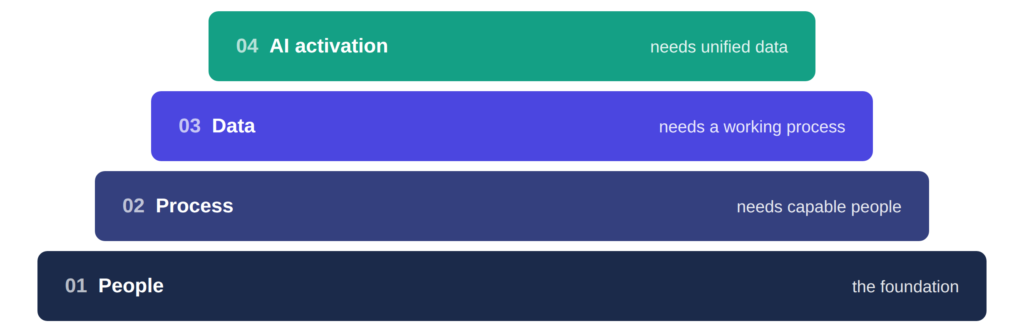
Audit them in isolation and you treat symptoms. Audit them together and the sequence of fixes becomes obvious.
As we covered in our work on MarTech value engineering, the recoverable value in most mature stacks isn’t in the tools you don’t own. It’s in the capabilities you’ve already paid for and aren’t using. The four dimensions are how you find them.
| DIMENSION | WHAT THE AUDIT CHECKS | PRACTICAL TAKEAWAY |
|---|---|---|
01 People Can your team run it? |
Who operates each platform, single points of failure, admin time vs. revenue work, and whether there’s a plan to close skills gaps. |
Map capability against your most important platforms, not the whole stack. Know where the dependency sits and whether it’s safe. |
02 Process Is it embedded? |
How context flows between systems, who owns each handover, and whether there’s a governance model for adopting and rolling back change. |
Trace one real customer journey end to end and watch where the data stops moving. |
03 Data Worth activating? |
What’s landing in the warehouse or CDP, how clean and current it is, and which platforms are genuinely connected versus nominally integrated. |
Treat data readiness as strategy, not an IT ticket. If it can’t support a unified view today, that’s your first investment. |
04 AI activation Strategic or cosmetic? |
Not whether each AI feature is switched on, but what data it operates on and whether that data is unified enough to produce real intelligence. |
List every AI feature you pay for, then ask what data each draws on. The answers reorder your priorities fast. |
Start where the gap is widest
You don’t need to fix all four dimensions at once, and you shouldn’t try. Auditing them together tells you which gap is costing you most right now. Fix that one first.
For most teams the answer isn’t a tool they’re missing. It’s a capability they’ve already paid for and never switched on, a signal that never reaches the next system, or a data foundation that quietly caps everything above it.
Find that, tie it to a commercial outcome, and give it an owner. That’s how an audit becomes a roadmap instead of another deck that dies in budget season.
Dexata helps enterprise marketing teams run structured MarTech value audits across people, process, data, and AI. If you want to understand the value sitting unused in your current stack, get in touch.
Get Your MarTech Value Audit
Identify underutilised capabilities and high-impact optimisation opportunities.
About The Author

Charlie Nicholls