


I love movies, specially the animation movies for kids as these are a fantastic source of learnings. Many of these learnings are directly applicable to the field of MarTech as well. For example, take the popular 2007 movie Ratatouille. In this movie, Chef Gusteau’s motto was simple. Anyone can cook. Thats so aptly applicable to MarTech where AI has made many activities so easy.
However, Gusteau also never claimed everyone can run a kitchen.
In the movie, Remy could cook brilliantly. However, the restaurant still needed Colette to teach technique. It still needed a brigade system so plates left the pass in the right order. And it still needed someone deciding what the kitchen actually stood for.
AI has just handed every marketer a set of knives. Anyone can cook now. That doesn’t mean the kitchen runs itself.
This is exactly where the MarTech Centre of Excellence (COE) finds itself right now. For years, a MarTech COE, was the team everyone queued up for. Need a tag deployed? Ask the COE. Need a campaign built in your CDP? Ask the COE, then wait three weeks.
AI tools have emptied that queue. Marketers can now build a landing page, a segment, or a campaign brief with a single prompt. So where does that leave the MarTech COE? Not out of a job. Its actual job hasn’t changed at all.
That job has always been the same. Drive adoption of the platforms the business already pays for. Turn that adoption into revenue. AI doesn’t rewrite that mission. It gives the MarTech COE a much bigger toolkit. It also adds a few new jobs to go with that toolkit.
This article breaks down what a MarTech COE did before AI, and what stays exactly the same now. It looks at the roles the function needs. That includes two jobs AI adds rather than removes. One is spotting AI-led use cases inside the stack. The other is training teams on the AI already built into their platforms. It covers how to measure whether yours is actually working. We’ll also walk through a real campaign disaster a strong COE could have stopped.
What A MarTech COE Used To Do
Before AI, a classic MarTech Centre of Excellence ran on six pillars. MarTech.org’s breakdown of the anatomy of a martech COE captures this structure well. Those pillars are
- strategy and planning
- technology and implementation
- data and analytics
- execution
- governance and compliance
- programme management
In practice, this meant the MarTech COE owned everything. It picked the tools. It built the campaigns. It ran the reports. It approved every change before anything went live. Marketing teams brought requests. The COE turned those requests into delivery.
This delivery-support model made sense at the time. Building anything in martech required real specialist skill. You needed to know Adobe Target’s profile scripts. You needed to write a segment rule in a CDP. You needed to debug a broken tag in Tealium. Few people outside the COE had those skills. So the COE became the bottleneck by default, not by choice.
In kitchen terms, the COE was the only one who could cook. Everyone else wrote the orders.
That bottleneck was frustrating. But it was also useful. It meant one team held the context. It meant governance had a home. Nothing shipped without someone checking it first.
Underneath all six pillars sat one job, and it’s worth stating plainly. Get the business using the platforms it had already bought. Turn that use into revenue. That’s still the job today. AI hasn’t changed it. It’s just changed what the job looks like day to day.
MarTech COE in the AI Era
Then AI arrived. It didn’t just speed up the COE’s own work. It handed the same building tools to everyone else, too.
Marketers can now describe an audience segment in plain English. They get a working query back. Generative tools draft campaign copy, build landing pages, and summarise performance data. No code required. TechTarget’s research on citizen developers puts it well. The fluency bar has shifted “from ‘can you code’ to ‘can you reason about the problem.'” That one line sums up the disruption facing every MarTech COE today.
Scott Brinker, one of the most prominent voices in the MarTech domain, puts it even more directly. He argues that AI agents are becoming the new orchestration layer across the martech stack. They connect apps. They execute tasks that used to need a specialist and a support ticket. MarTech Conference research backs this up too. AI is reshaping marketing teams from the inside dissolving the old silos between creative, media, analytics, and operations.
Here’s the catch. Speed without oversight is how organisations get into trouble. When any team can spin up an AI-built segment or a rogue automation, “shadow IT” gets a sequel: Shadow AI. Cyber Defense Magazine calls it exactly that. It describes shadow AI as untapped energy that needs illuminating, not shutting down. Ignore it, and it quietly turns into a compliance and data quality problem.
This is the real disruption. It was never about AI writing better subject lines. It’s about who gets to build, and what happens when everyone can.
Gusteau’s kitchen had the same problem, incidentally. Remy’s talent was real. The chaos only stopped once the brigade got organised around him.
AI Changes The Toolkit, Not The Mission
So what does a MarTech COE do when it no longer owns delivery? It moves up the value chain. But the goal stays fixed. Drive adoption of the platforms the business already owns. Turn that adoption into measurable value. AI doesn’t replace that goal. It hands the MarTech COE new ways to hit it.
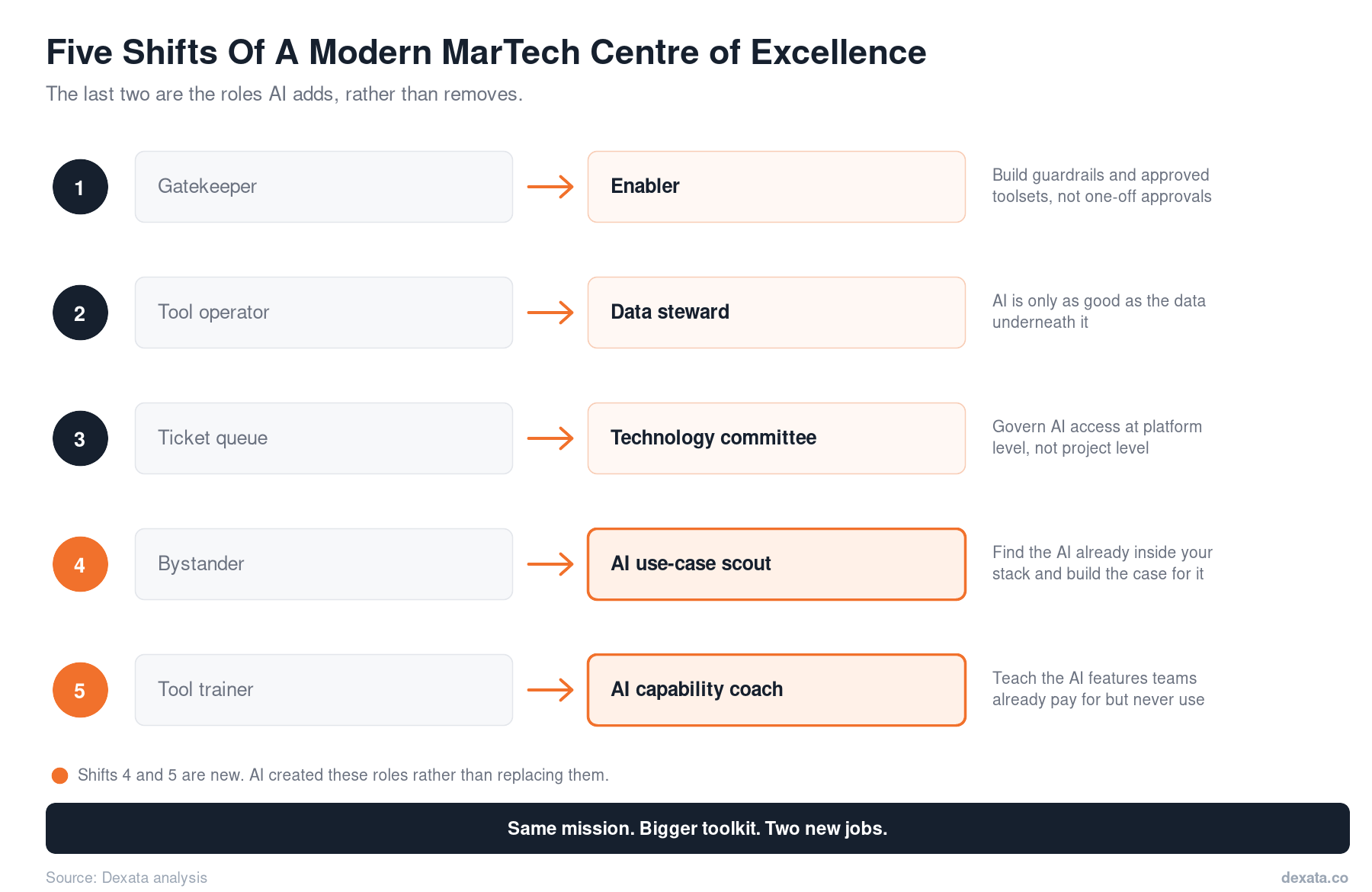
Five shifts define how a modern MarTech COE gets that job done.
1. From gatekeeper to enabler
The old MarTech COE approved requests one at a time. The new one builds the guardrails, templates, and approved AI toolsets. That lets marketers build safely, without waiting on a ticket. MLflow’s research on AI Centres of Excellence in 2026 describes this well. The function shifts from reviewing everything to building shared infrastructure that every team can use.
2. From tool operator to data steward
When a marketer can generate a campaign in minutes, that campaign is only as good as the data behind it. This is where a MarTech COE earns its keep now. It keeps the warehouse clean. It keeps the identity graph trustworthy. It stops AI quietly running on stale or fragmented data. Get this wrong, and every AI feature you switch on becomes activation theatre. We unpack that idea in the four dimensions every MarTech value audit must cover.
3. From ticket queue to technology committee
Instead of approving individual builds, the MarTech COE increasingly leads a standing governance body. MarTech.org’s recent guide on building a technology advisory committee shows this trend clearly. Organisations need a group that reviews AI tools and data access at the platform level, not the project level.
4. From bystander to AI use-case scout
Most martech platforms already ship with AI built in. Think predictive audiences in the CDP, AI-assisted testing in Optimizely or Adobe Target, propensity scoring in the CRM. A modern MarTech COE doesn’t wait for marketing teams to stumble onto these features by accident. It actively scouts them. It builds the business case, then drives the rollout. That’s the same adoption job as always. It’s just aimed at AI-powered features now, not just the platform itself.
5. From tool trainer to AI capability coach
Training used to mean teaching a team how to build a segment or set up a campaign. Now it also means teaching them how to use the AI already sitting inside their stack. Most teams barely scratch the surface of it. Gartner’s benchmark on stack utilisation, more on that shortly, isn’t only about platforms sitting unused. It includes AI features inside platforms teams already know how to use, sitting switched off. Closing that gap is squarely a MarTech COE job.
This is the Colette role. Remy had the instinct. She had the technique, and she taught it. Your teams have AI tools. Someone still has to show them what good looks like.
Pre-AI vs Post-AI: The MarTech Centre Of Excellence, Function By Function
Here’s how each classic pillar of a MarTech Centre of Excellence has changed, mapped side by side.
Notice the pattern. Every row moves from “doing the work” to “making the work trustworthy.” That’s the whole story of the MarTech COE, in one table alone.
How To Measure MarTech COE Maturity And Success
A MarTech COE without KPIs is just an opinion with a job title. Here’s a simple way to track where yours sits, and where it needs to go.
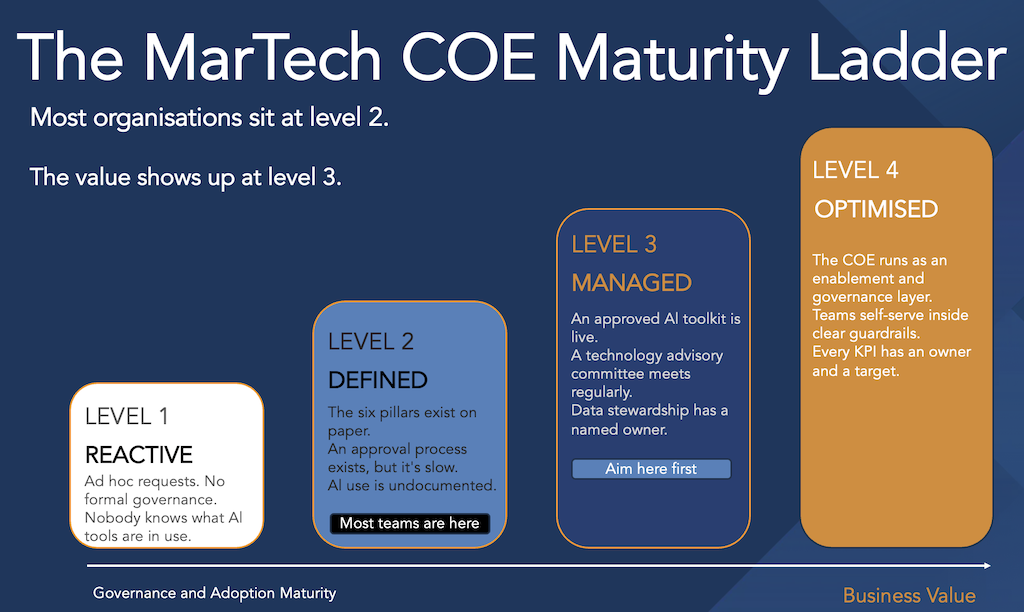
Level 1: Reactive
Requests come in ad hoc. There’s no formal governance. Nobody knows how many AI tools are in use across the business, let alone whether they’re sanctioned.
Level 2: Defined
The six classic pillars exist on paper. An approval process exists, but it’s slow. AI use is informal and undocumented.
Level 3: Managed
An approved AI toolkit is live. A technology advisory committee meets on a regular cadence. Data stewardship has an owner, not just a mention in a job description.
Level 4: Optimised
The MarTech Centre of Excellence runs as an enablement and governance layer. Citizen builders self-serve inside clear guardrails. Every KPI below has an owner and a target.
Most organisations sit at Level 2 today. Moving to Level 3 is where the real value shows up.
KPIs that actually matter
None of this needs to be complicated. Pick three or four KPIs to start, review them monthly, and expand the list once the reporting habit sticks.
The Risk Of Standing Still
Some MarTech COE teams will read this and keep operating exactly as before. That’s a real risk, not a safe choice.
Gartner’s 2025 Marketing Technology Survey found stack utilisation across enterprises still sits at just 49%. We covered that number in more detail in our audit framework piece. Add AI-generated sprawl on top of unused capability, and the gap between spend and value only grows.
There’s a data security angle here too. We wrote recently about AI being weaponised against the MarTech data layer itself. Think synthetic bot traffic and fraudulent lead injection. A MarTech COE without an updated governance model is defending yesterday’s threats. Today’s threats walk straight past it.
What Happens Without One: Starbucks Korea’s Tank Day
Ian Malcolm’s line in Jurassic Park has aged unusually well.
“Your scientists were so preoccupied with whether they could, they didn’t stop to think if they should.“
AI has made “could” almost free. “Should” still needs a human in the room. Starbucks Korea found that out the hard way.
In May 2026, the Korean operator, run by Shinsegae Group, launched a promotion for a new steel tumbler. The team called it “Tank Day” and scheduled it for 18 May. They used an AI tool to help generate the campaign concept and slogan. Nobody flagged the date. Nobody flagged the slogan either.
The problem: 18 May is the anniversary of the 1980 Gwangju Uprising. It’s one of the most painful dates in modern Korean history. The campaign’s slogan, translated roughly as “thwack it on the table,” made things worse. It echoed a phrase Korean police used in 1987. They had used it to cover up a student protester’s torture and death. According to reporting on the incident, a Shinsegae executive later admitted the failure plainly. “Not a single objection was raised during either the planning or approval stages,” he said.
The fallout was brutal. Card payment volumes at Starbucks Korea locations fell 26% within a single week. The CEO was dismissed. Police opened a criminal investigation. All 2,000-plus Korean stores closed early on a single day. Every employee attended mandatory history and social-sensitivity training. Shinsegae’s chairman gave a televised apology, bowing on camera.
Here’s the part that matters for every MarTech COE reading this. Shinsegae’s fix came only after the damage was done. It introduced a social-sensitivity checklist and mandatory external review before any campaign launch. That’s a governance function. It’s exactly what a technology advisory committee and a sensitive-dates calendar are built to catch, before launch, not after.
A functioning MarTech COE doesn’t slow AI down. It puts one human checkpoint between an AI suggestion and a public launch. In this case, that single checkpoint could have prevented a national boycott, a CEO’s dismissal, and a criminal investigation.
How To Evolve Your MarTech COE
None of this requires burning down what you’ve built. It requires redirecting it. Here’s where to start.
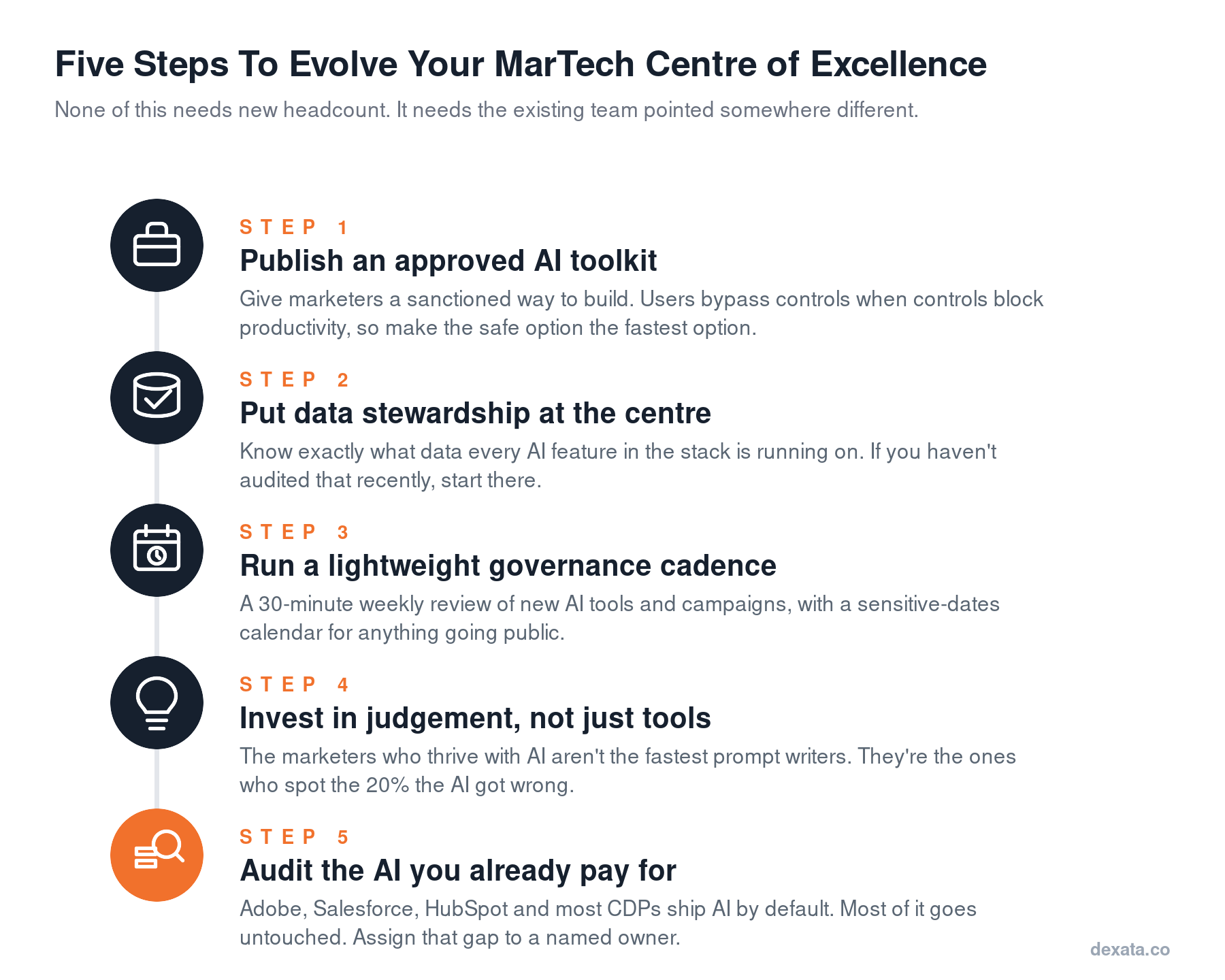
- First, publish an approved AI toolkit. Give marketers a sanctioned way to build. That way, they aren’t tempted to reach for an unapproved tool. Cyber Defense Magazine’s research is blunt here. Users bypass controls when controls block productivity. So make the safe option the fastest option.
- Second, put data stewardship at the centre of the role. Your MarTech Centre of Excellence should know exactly what data every AI feature runs on. If you haven’t audited that recently, our four-dimensions framework is a solid place to start.
- Third, stand up a lightweight governance cadence, including a sensitive-dates calendar for anything AI touches before it goes public. You don’t need a monthly meeting that drags on for hours. A fast, 30-minute weekly review of new AI tools and campaigns keeps pace with how quickly teams want to move.
- Fourth, invest in judgement, not just tools. The marketers who thrive with AI aren’t the fastest prompt writers. They’re the ones who spot the 20% an AI got wrong. They know what to do about it. We explored this same idea in our piece on choosing between Neo’s learning and Mr Anderson’s stagnation. Continuous learning beats static training. It applies directly here.
- Fifth, run a quarterly audit of AI features already sitting inside your stack, and who’s actually using them. Adobe, Salesforce, HubSpot, and most CDP vendors now ship AI capability by default. Most of it goes untouched. Assign it to the AI use-case lead. Their job is to close that gap, not just watch it grow.
- Finally, you don’t have to run this shift alone. Dexata’s Collaborative COE gives brands an external execution team. It works alongside your own people, closing the capability gap. That frees your MarTech Centre of Excellence to rebuild around governance, adoption, and value.
Conclusion
Strip away the AI headlines, and the mission of a MarTech COE hasn’t moved. It is still there to drive adoption of the platforms the business already owns. It still turns that adoption into revenue. That was true before AI. It’s true now. AI hasn’t rewritten the job description. It has changed the toolkit. And it has added two jobs that didn’t exist before. One is scouting AI-led use cases already sitting inside your stack. The other is training teams to actually use them.
A MarTech COE built for the AI era gets measured differently to one built for a pre-AI world. It’s judged by how much it makes trustworthy, governed, and genuinely adopted. That means new roles, from an AI use-case lead to an AI capability coach. It means real KPIs, tracked monthly, not filed away in a strategy deck. And it means learning from both sides of the ledger. Starbucks Korea shows what a missing checkpoint costs. Our own case studies show what a properly governed, properly enabled COE delivers in hard commercial numbers.
Gusteau was right all along. Anyone can cook. But the restaurant still needs someone running the kitchen, teaching the technique, and deciding what goes out to the guests. That job just got a lot more interesting.
That’s not a smaller role than before. It’s arguably the most important one in your marketing organisation right now.
Dexata helps enterprise marketing teams evolve their MarTech COE for the AI era. That covers data stewardship, governance, and hands-on execution support. If you want a partner to help make that shift, contact us.
About The Author

Rajneesh Gautam