



Every major MarTech vendor has spent the last year or so bolting AI onto their platforms. Adobe, Salesforce, Tealium, Microsoft, Google, MoEngage, if you use it, it’s probably shipped a new AI feature in the last six months, maybe more than one. Most marketing teams haven’t had time to properly evaluate any of it, let alone roll it out.
Which is a problem, because the same organisations struggle with the MarTech they already have. Gartner’s 2025 Marketing Technology Survey put active tool usage at 49% – worth a read if you haven’t seen it. Half the stack, roughly, sits there unused. Stacking AI on top of that doesn’t fix anything. If anything it makes the problem harder to see, because now there’s a shinier reason to feel like progress is being made.
So having access to AI and actually getting value out of it turn out to be two very different things. Some organisations are sitting on capability they could switch on next month. Others have the same capability, technically, but nowhere near the foundations needed to use it properly. Both situations are common. The trouble is most conversations about “AI readiness” don’t distinguish between them.
Capability isn’t the constraint
Adobe and Oxford Economics ran a survey for their 2026 AI and Digital Trends research and asked MarTech leaders what’s actually holding back agentic AI adoption. Seventy percent pointed to unclear ROI or a weak business case. Not a lack of tools. Not technical limitations. A weak business case which usually means the initiative started with a feature someone wanted to try, rather than a problem worth solving.
That’s the pattern we keep running into. Platforms get bought, get partially implemented, then get left. Nobody set out for that to happen, it’s just what tends to occur when the buying decision is driven by the feature list rather than the outcome. AI hasn’t changed the pattern. It’s just made it move faster, because the features keep arriving whether or not anyone’s ready to use the last batch.
For some of our clients that’s genuinely good news, once we dig in. There are AI-powered use cases sitting in their stack right now that would take weeks to activate, not months, because the licence is already paid for and the data’s mostly in place. For others the opportunity is just as real but the honest answer is: not yet. The data’s not clean enough, the platforms don’t talk to each other, or nobody actually owns the use case. Neither answer is wrong. What’s wrong is assuming you know which one you’re in before you’ve checked.
For example, imagine a retailer already using a MarTech platform that includes AI-powered product recommendations. Rather than building a new recommendation engine or buying another tool, it could use the behavioural and purchase data it already collects to personalise products shown on its website or in email. The capability, data and activation channels are largely there — making this potentially a weeks-not-months opportunity.
Compare that with introducing AI personalisation across channels when customer data and identities aren’t connected. That’s a foundations project rather than a quick win.
That distinction matters. Sometimes the fastest route to AI value isn’t building something new. It’s finding a better use for capability you’ve already paid for.
A genuine quick win tends to look like this:
A genuine quick win tends to share a few traits, and it’s worth checking for all of them rather than assuming from one:
The feature is already available.
Somewhere in the stack, the AI capability exists and is licensed, it’s simply not part of anyone’s day-to-day workflow. This is more common than most teams realise, because vendors increasingly bundle AI features into existing tiers rather than selling them as an add-on, so nobody notices they’ve already paid for it.
The underlying data is close enough.
It doesn’t need to be perfect, it needs to be reasonably clean and already collected for something else. If the data would need to be built from scratch, that’s a different project with a different timeline.
The blocker is ownership, not architecture.
Nobody has picked it up, rather than nobody being able to. That’s a resourcing and prioritisation problem, which is fixable in weeks. A genuine integration gap or governance hole isn’t.
Something similar already works.
If a comparable, non-AI capability is already embedded in how the team operates, the operating model, approvals and reporting habits already exist. The AI version just slots into a pattern that’s already proven.
Where an opportunity is missing most of those, it doesn’t mean shelve it. It means the honest next step is building the foundation first, not switching something on and hoping it sticks.
Start with the outcome, not the AI feature
Whenever a new capability lands, the instinct is to go looking for somewhere to use it. That’s backwards. Better to start with what you’re actually trying to move (growth, retention, efficiency, whatever it is) work out which use cases would move it, and only then ask whether AI belongs in any of them.
Plenty won’t need it. A few will benefit modestly. A handful will be genuinely transformed. Starting from the outcome keeps the whole exercise honest, because it’s much harder to talk yourself into a use case that doesn’t actually help anyone once you’ve named the outcome you’re chasing first. It’s the same logic behind MarTech Value Engineering, which we wrote about a while back – buy less, use more.
What “ready” actually means
Getting value from AI takes more than the right software licence. Readiness depends on the wider MarTech ecosystem, and most organisations will be stronger in some areas than others.
1. Strategy and architecture.
Can the stack support the use case, or will its architecture get in the way?
2. Data and intelligence.
Is the underlying data connected, accessible and trustworthy enough for AI to act on?
3. Activation and orchestration.
Can AI-generated insights or recommendations actually be turned into action across channels?
4. Experimentation and personalisation.
Can you test, learn and optimise rather than simply putting AI-driven experiences into production?
5. Search and discovery.
Are you accounting for how AI is changing the way customers discover and evaluate your brand?
Underneath all five sit the same four things that decide whether any MarTech investment pays off – people, process, technology and governance. Put an AI feature on top of a team with no mandate to use it, or data nobody trusts, and it doesn’t matter how good the model is. It won’t go anywhere.
Separate the quick wins from the foundations
This is usually where the interesting work happens. Most organisations already own more capability than they’re using. The gap isn’t the technology, it’s everything around it: data that’s siloed rather than connected, integrations that were never finished, nobody clearly owning the use case, governance that hasn’t caught up. It’s exactly what most MarTech audits fail to catch, because they inventory the stack instead of asking whether it’s creating value.
Not every opportunity should get the same treatment though. Score each one on value, feasibility and time to value, and two very different piles emerge:
| Quick wins | Foundation-first opportunities | |
|---|---|---|
| Existing capability | Already there, just underused | Partial, or blocked somewhere |
| Data and governance | Largely sorted | Needs work first |
| Time to value | Weeks | Months |
| Right move now | Activate it | Sequence it into the roadmap |
Getting that split right is the difference between a plan that shows movement next quarter and one that’s still stuck on prerequisites eighteen months from now. It’s also why the MarTech Centre of Excellence hasn’t gone away. It’s just accountable for more than it used to be.
Whatever comes out of this shouldn’t just be a list of AI features worth switching on. Every use case should be traceable back to a business reason:
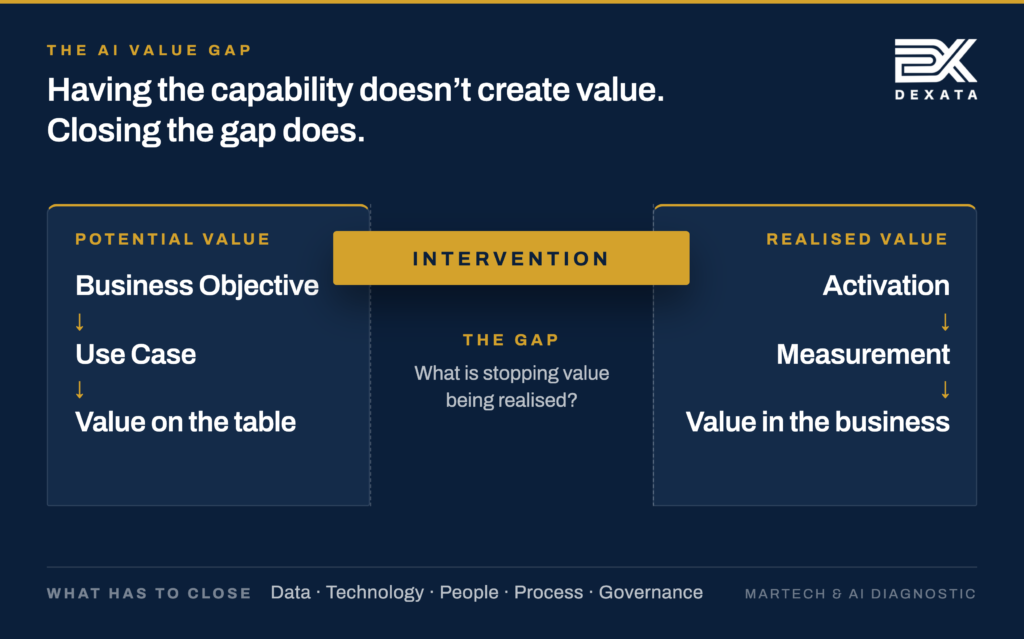
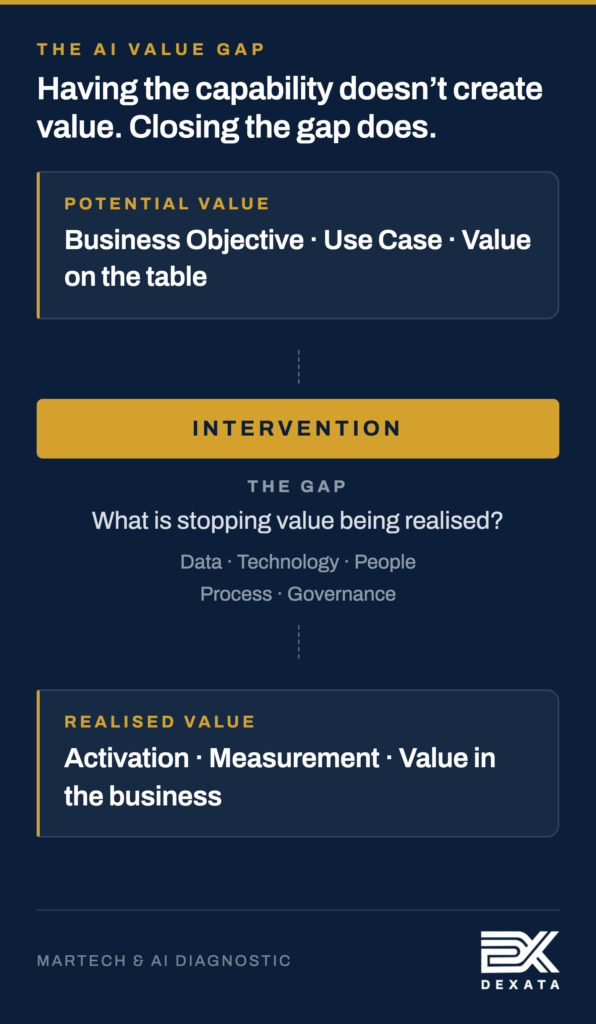
Miss that chain and you end up with a roadmap of things that were possible, not a roadmap of things worth doing.
Where to start
Before the next platform purchase, or the next AI add-on, it’s worth sitting down and answering three questions honestly:
- What outcome are we trying to shift, and which use cases would move it?
- Which could our existing stack support today?
- What’s the smallest change needed to unlock the rest – data, integration, process, ownership or skills?
Answering those questions helps separate the AI opportunities that can create value now from those that need more work first.
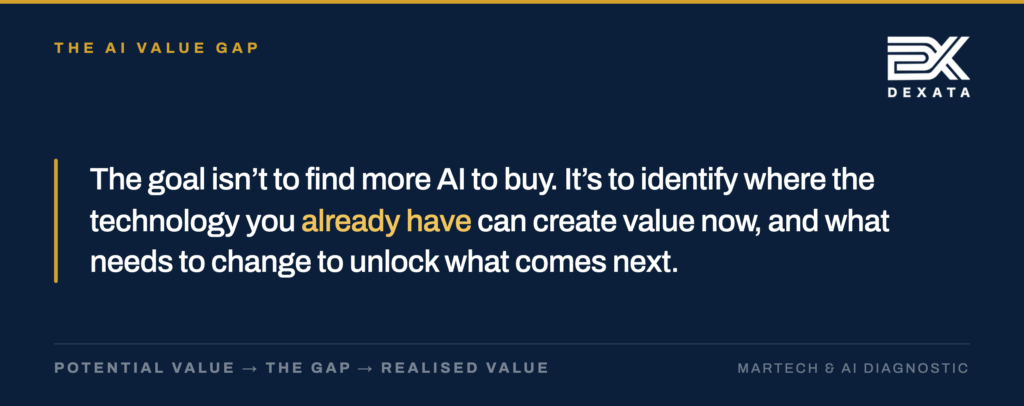
That’s the thinking behind our MarTech & AI Diagnostic: start with the outcomes, assess what your existing stack can already enable, and build the roadmap from there.
If you’d rather test the water first, we run a complimentary MarTech AI Value Snapshot – a quick look that surfaces two or three AI-powered use cases, flags likely quick wins, and names the main barriers standing in the way. Drop us a line.
About The Author