

In 1983, historian Ruth Schwartz Cowan published a book with a cheeky title: More Work for Mother. Her question sounded simple. Washing machines, vacuum cleaners and modern cookers had arrived in millions of homes. So why didn’t housework get any shorter?
Her answer surprised people. The machines made each job easier. However, standards rose to match. Families expected cleaner homes, higher standards of hygiene and more varied meals. Meanwhile, the household help disappeared. The work changed shape, but it never really shrank (The Christian Science Monitor).
I think about that book a lot these days. AI now does plenty of chores for marketing and analytics teams. It writes the weekly performance summary. It checks tags, builds segments and drafts test write-ups. Hours come back to us. Then, somehow, they fill right back up.
Suddenly, someone has to read every AI report. Someone has to proofread every AI draft. And someone has to explain why the AI-written insight told the CFO the wrong story. That’s the AI productivity paradox. Most MarTech leaders I speak to live inside it right now.
So, does AI really save us time? Or does it just move the work around? Let’s dig in.
What Is the AI Productivity Paradox?
Here’s the short version. The AI productivity paradox describes a simple gap. AI makes individual tasks faster, yet teams don’t feel more productive. Often, they feel busier.
Economists have seen this film before. In 1987, Nobel economist Robert Solow made a famous quip. He said the computer age showed up everywhere except the productivity statistics (Brookings). One popular explanation? Big technologies, like electricity before them, take years to pay off. AI looks set to follow the same script.
The data backs this up. Upwork surveyed 2,500 workers and executives across the US, UK, Australia and Canada. 96% of C-suite leaders expected AI to lift productivity. Yet 77% of employees using AI said it had added to their workload (Upwork, 2024). Nearly half (47%) didn’t know how to deliver the gains their bosses expected.
So where did the extra work come from? According to the same research, 39% of employees spent more time reviewing and moderating AI content (Small Business Trends). In other words, AI handed people a brand-new job: checking AI’s homework.
Where Does the Time AI Saves Actually Go?
Let’s take a typical digital analytics and MarTech team. AI now handles plenty of their mundane jobs well:
- Writing the weekly or monthly performance commentary
- Spotting anomalies in traffic or conversion data
- Checking tags and data layer values
- Building audience segments from plain-English prompts
- Summarising A/B test results
- Drafting copy variants for tests and emails
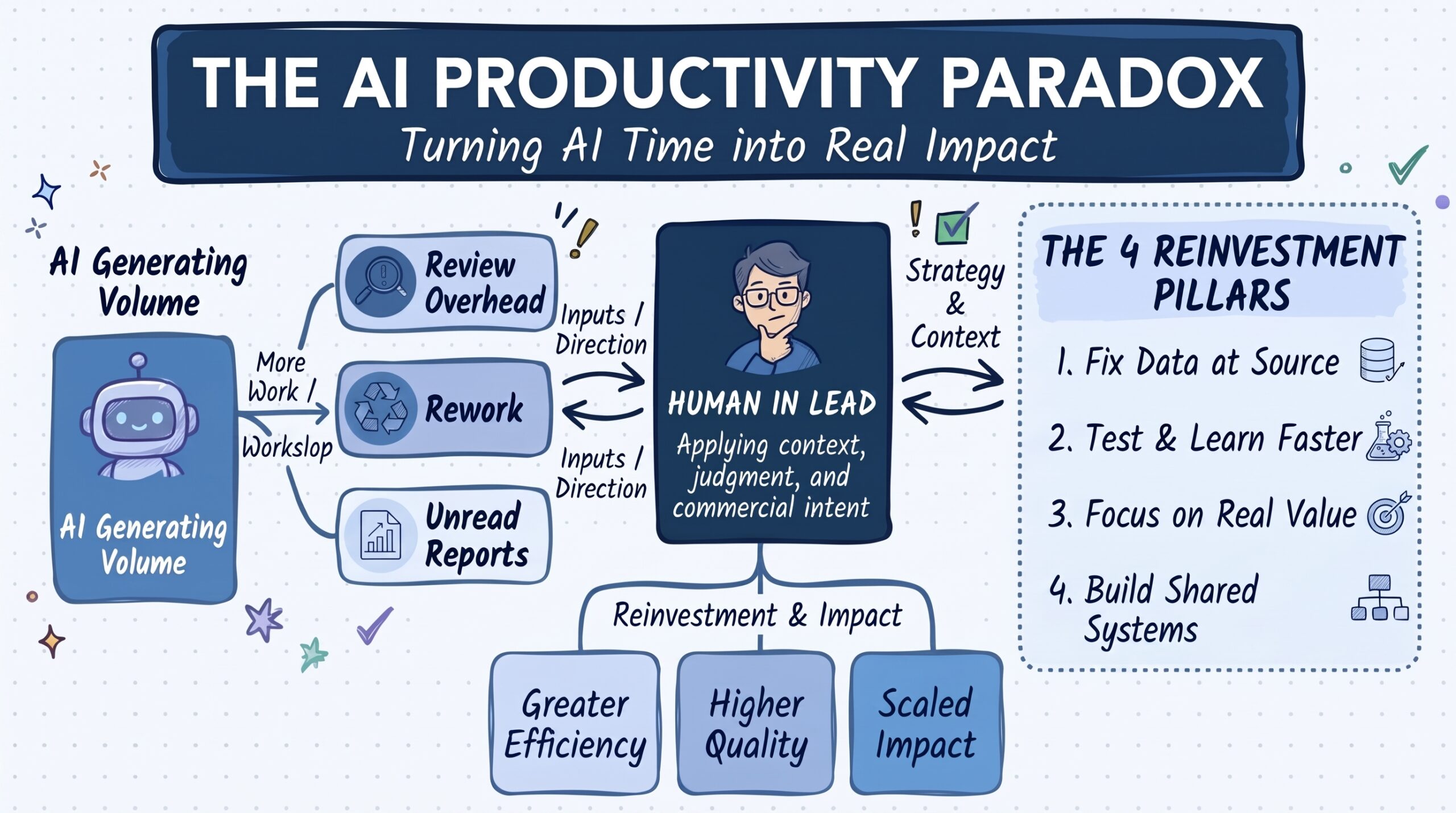
Each of these used to take hours. Now it takes minutes. However, the saved time rarely flows into strategy. Instead, it leaks into three places.
First, review. Every AI output needs a human eye. A dashboard summary that’s 90% right is still 10% wrong. Somebody has to find that 10%.
Second, rework. When AI gets something wrong, fixing it can take longer than doing it from scratch.
Third, model arbitration. Industry benchmarks (like a16z’s enterprise AI studies) show that over 60% of enterprises now run multi-model workflows. In MarTech, teams burn hours playing referee: asking one model to build an audience segmentation strategy, another to generate the SQL and tag logic, and a third to validate it. Reconciling conflicting assumptions, hallucinated parameters, and inconsistent data schemas between models quickly devours the initial time saved.
Fourth, more output. AI makes reports cheap, so teams produce more of them. Nobody reads the extra ones. Back in 1955, historian C. Northcote Parkinson noted that work expands to fill the time available. AI hasn’t repealed Parkinson’s Law. If anything, it has turbocharged it.
Here’s the uncomfortable bit. We aren’t great at judging this ourselves. In a 2025 trial, research group METR gave 16 experienced software developers real tasks. With AI tools, they took 19% longer. Yet afterwards, they believed AI had made them about 20% faster (METR, 2025).
Does AI Create More Work and Pressure?
Often, yes, at least at first. The same Upwork research found that 71% of full-time employees felt burnt out. Meanwhile, 65% struggled with their employer’s productivity demands (Audacy). And 40% felt their company asked too much of them on AI.
The pattern looks familiar. Leaders buy the AI licence. Then they quietly raise the targets. “You’ve got AI now, so can you do twice as much?” Targets rise before the gains show up. Meanwhile, the learning curve eats the very hours AI promised to give back.
That’s not an AI problem. It’s a leadership problem. And it’s fixable.
When leadership raises output targets without fixing the underlying workflows, teams take the only shortcut left: blindly following AI. Deprived of the time needed to interrogate AI outputs, analysts and marketers accept first drafts as final answers just to clear the backlog. The immediate rush to hit artificial volume goals creates a dangerous, expensive downstream byproduct that researchers at BetterUp Labs and Stanford call: workslop.
Their findings, published in Harvard Business Review, should worry every marketing leader. 41% of workers have received workslop. Each instance costs nearly two hours of rework (HBR, 2025). The researchers put the hidden cost at $186 per employee per month. For a 10,000-person company, that adds up to over $9 million a year (The Decoder).
A recent example is the Starbucks South Korea debacle: under pressure for rapid promotional turnaround, unvetted AI copy and concepts were pushed straight to launch, missing crucial cultural context and triggering an immediate 26% drop in store card spend alongside executive fallout."
What Should MarTech Teams Do with the Time AI Saves?
The AI productivity paradox is not destiny; it is an operational choice. If you don’t deliberately ring-fence saved hours, review work and Parkinson’s Law will consume them.
High-performing teams trade administrative throughput for four strategic capabilities that compound in value:
1. Fix Your Data at the Source
AI tools and automated campaigns are only as smart as the information you feed them. If your website drops customer details, mixes up user accounts, or misses consent tags, AI will simply make bad calls a whole lot faster.
Hand over to AI: Spotting missing website tags, running repetitive data checks, and writing simple tracking code snippets.
The Trap: Letting team members paste unchecked AI code directly onto your live site, silently breaking your tracking.
Where to Spend Saved Time: Clean up tracking so web and app data tell the exact same story, fix broken cookies, and ensure marketing consent rules actually work.
The Proof: Auditing 273 tracking tags that fired before consent helped a software firm remove massive privacy risks. For a major transport operator, connecting broken customer journeys lifted ad returns by over 15%.
2. Test and Learn Much Faster
The point of MarTech isn’t to blast out more campaigns—it’s to find out what works faster than your competitors. Volume alone is just spam; speed only matters if you learn something.
Hand over to AI: Drafting rough copy variations, pulling together basic audience lists, and formatting test briefs.
The Trap: Testing tiny, pointless changes—like changing button colours fifty times—just because AI makes it effortless.
Where to Spend Saved Time: Moving from quarterly campaigns to weekly experiments, speaking with customers to build smarter test ideas, and keeping a shared record of every win and loss so future projects don’t repeat mistakes.
The Proof: Klarna used AI to drop creative production time from six weeks to seven days. They used that speed to run tests far more often, while cutting their marketing budget by 11%.
3. Focus on Real Business Value
Being busy isn’t the same as making an impact. Most companies use less than half the tools they pay for. Churning out ten extra reports or five more emails is useless if sales and margins don’t move.
Hand over to AI: Pulling routine metrics from dashboards, building basic spreadsheets, and drafting weekly budget summaries.
The Trap: Counting “hours saved” or “content produced” as success instead of looking at pipeline growth, customer acquisition costs, or revenue.
Where to Spend Saved Time: Checking the features you already pay for in your current tools before buying new ones, proving whether campaigns genuinely generated sales, and ditching duplicate software.
The Proof: Instead of buying new AI tools, a B2B team spent freed-up time turning on three features already sitting inside their existing software (lead scoring, sales alerts, and progressive forms). Within six months, they cut sales cycles by 22% and increased qualified leads by 40% without spending an extra penny.
4. Build Shared Systems and Help Your Team Level Up
Five analysts using ChatGPT alone in separate browser tabs doesn’t make an AI-powered team. It just means five people are independently fixing the same mistakes and keeping the answers to themselves.
Hand over to AI: Writing first-draft code queries, creating basic outlines, and formatting notes.
The Trap: Working in secret silos, where everyone relies on the exact same generic AI prompts and comes up with the same bland ideas.
Where to Spend Saved Time: Setting up a shared library of tested prompts and setup guides, creating clear checklists to review AI work before it goes out, and coaching people on critical thinking and data skills.
The Proof: Microsoft’s 2026 Work Trend Index found that organisational factors, such as culture, manager support and training, account for 67% of AI’s reported impact. Individual mindset and behaviour account for just 32% (Microsoft). IKEA used AI to answer routine customer queries, then retrained 8,500 staff to become remote design consultants driving €1.25 billion in remote sales.

You don’t need to tackle all pillars at once. Pick the area where your team loses the most value today. Then point your first saved hours there.
Couldn’t AI Just Do All of This Eventually?
It’s a fair challenge, and someone in your leadership team will raise it. If AI can write reports, why can’t it fix data or set strategy too?
Partly, it can. In the examples above, AI handled plenty of the heavy lifting. So the real question isn’t “human or AI?” for whole jobs. Instead, it’s which parts of each job belong to whom.
Here’s my honest take: I don’t know where the technology’s ceiling is, and anyone pretending to have a crystal ball is guessing.
Technology moves fast, but the lessons of the last two years are clear: stepping outside AI’s comfort zone still leaves models 19 percentage points more likely to get critical analysis flat wrong. Klarna’s leadership had to reverse course—stepping away from pure AI replacement to hire more humans back into the business. Meanwhile, Gartner predicts that half of the companies that cut staff in the initial AI rush will end up rehiring them by 2027. Why? Because pure automation stripped away the context, judgment, and human nuance that actually protect customer trust and commercial outcomes.
Only time will settle that debate. But while the future sorts itself out, you still have targets to hit this quarter. If you treat AI like a miracle worker that needs zero oversight, you’ll drown in workslop. If you use it to buy back time for clean data, faster tests, and sharper thinking, you win today, regardless of what tomorrow’s models can do.
Where to start?
Back to Ruth Schwartz Cowan. The washing machine never failed. It simply arrived without a plan for the time it saved. So that time quietly vanished into higher standards and new chores.
AI works the same way. It will happily do chores all day long. But leaders must decide where the saved time goes. Point it at reading more reports, and your team will sink. Point it at learning, and your team will win.
So here’s my challenge for this quarter. Find whether AI really saving your team some time or simply shifting it elsewhere. If it is really saving time, then ring-fence them for one high-value job, such as fixing a data gap or switching on an unused feature. Track the results. I suspect you’ll stop asking whether AI saves time. Instead, you’ll start asking what else your team can win.
At Dexata, we help enterprise teams turn AI efficiency into real conversion gains. We run MarTech value audits, activate unused capability, fix data foundations and set the governance that keeps workslop out. If you’d like a hand, explore our MarTech services or get in touch with our team.
About The Author